Shopify App Stack Cost Audit: Find Hidden Recurring Fees
Run a Shopify app stack cost audit that maps every paid capability, reconciles billing, tests dependencies and sets retain or retire decisions.
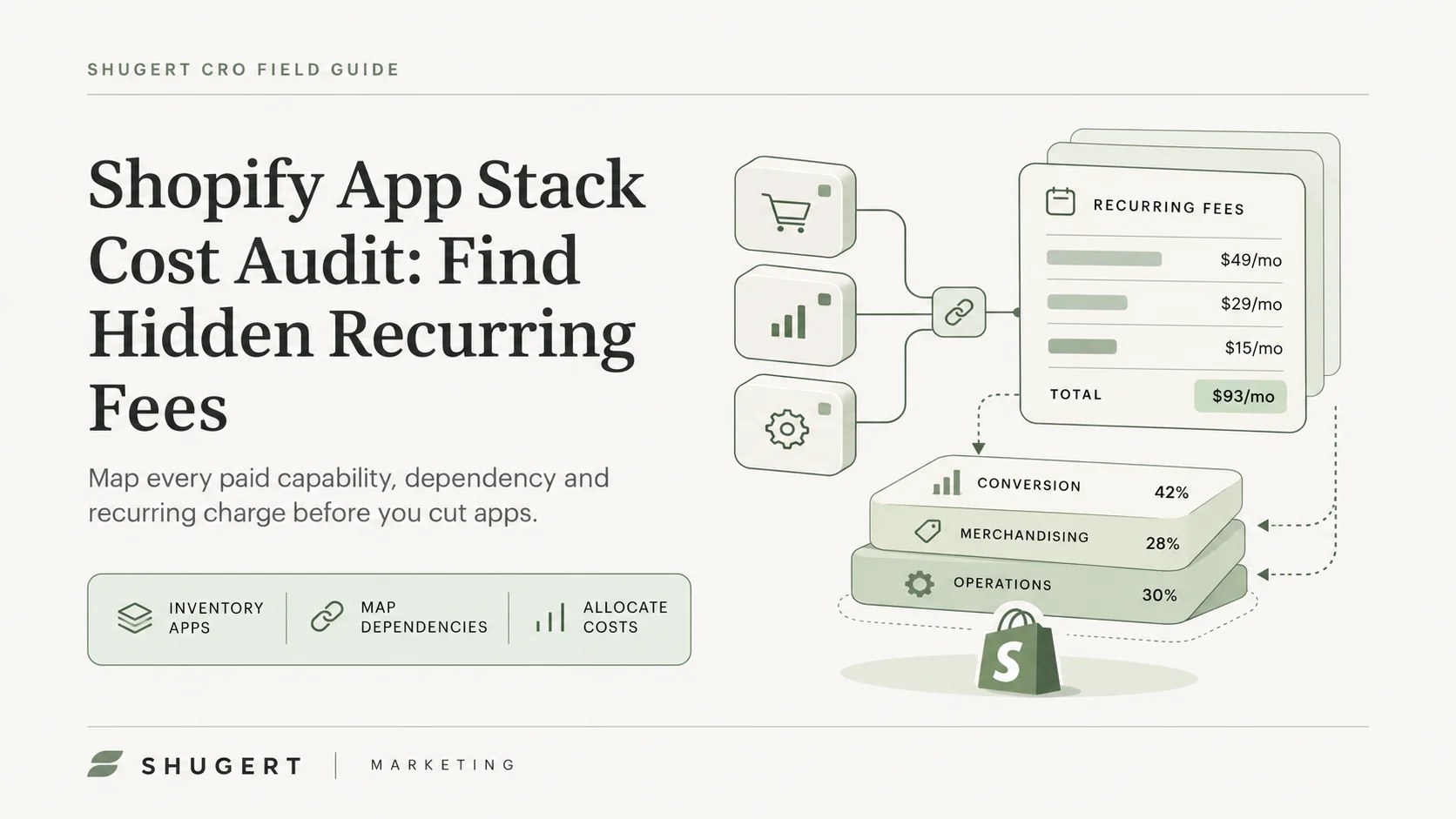
Cutting the app count is poor advice when nobody has traced what the apps do. A Shopify app stack cost audit should reconcile paid capabilities, billing records and live dependencies, not produce a shorter installed-app list. Otherwise, a merchant can cancel a cheap storefront widget and accidentally break wholesale order routing while leaving an expensive external contract untouched.
For established DTC and B2B merchants evaluating Shopify or Shopify Plus, the useful question isn't how many apps the target store needs. It's which capabilities deserve recurring spend, which can be consolidated, and which require a deliberate replacement before launch.
Need this built properly? Our custom Shopify development team designs themes, apps and integrations as maintainable systems.
Table of Contents
- Why the Plan Invoice Understates Your App Costs
- Build a Register of Every Paid Capability
- Reconcile the Register Against Billing and Live Dependencies
- Model Plan, Usage and Payment Fees Separately
- Allocate Each Capability to a Business Outcome
- Measure Storefront Cost Against Revenue on Key Templates
- Test Disabled States for Hidden Dependencies
- Decide Whether Theme Code or Subscription Wins
Why the Plan Invoice Understates Your App Costs
Third-party app cost is a billing reconciliation problem before it is a performance problem. A small stack with usage-based pricing and custom integration dependencies can cost more than a larger collection of inexpensive tools. The money hides in volume tiers, external contracts, annual commitments and maintenance work.
Vendor-published plugin-cost scenarios illustrate why platform fees alone do not describe operating expense. Shugert builds a merchant-specific baseline from actual invoices and dependencies rather than extrapolating a competing platform's figures.
Published app-cost examples vary with store size and usage. Shugert's engineering-led audit traces actual billing to live functionality, including externally billed services.
That is why the audit boundary needs to stay narrow. This exercise produces a capability-level total-cost model and a 12-month retain-versus-replace recommendation. Broader engineering estimates belong in the Shopify development cost guide, launch expenditure in the migration budget breakdown, and deeper speed analysis in the third-party app performance audit.
Finance may use a register or an app that tracks subscriptions to organize charges. Shugert goes beyond subscription visibility by reconciling invoices against theme, checkout and backend dependencies before proposing removal.
Audit boundary: Subscription visibility identifies a charge. Only workflow testing establishes whether the capability can disappear.
Independent billing cycles also complicate comparisons between an advertised monthly price and an accounting-period invoice. A fixed monthly plan may be only one line in the true cost. Usage charges, vendor invoices, currency differences and renewal dates all change the monthly equivalent, and backend-only integrations can carry no storefront signal at all. The foundation is a register that connects every paid capability to its cost, owner and operational purpose.
Build a Register of Every Paid Capability
App and script register fields
| Field | What to record | Source |
|---|---|---|
| Capability | Function the paid tool performs, such as reviews, subscriptions or ERP sync | Team interviews and workflow maps |
| Billing model | Fixed subscription, usage-based, one-time charge or credit | Shopify billing and app listing |
| Monthly equivalent cost | Fixed fee converted to monthly, plus the monthly average of the last 12 months of usage | Shopify billing export and vendor invoices |
| Usage metric and limit | Orders, contacts, events or SKUs, with tier limits and spending caps | Vendor dashboard and billing settings |
| Billing cycle and renewal | Independent 30-day or annual renewal date and cancellation terms | Shopify billing and vendor contract |
| Currency and external billing | Charges in another currency or billed outside Shopify | Finance card statements and vendor invoices |
| Business owner | Named person who approves retention or removal | Operations or finance lead |
| Dependencies | Theme embeds, pixels, webhooks, scripts and ERP or PIM links | Theme code, tag manager and integration logs |
| Support and maintenance cost | Internal hours or agency retainers tied to the tool | Engineering and support time logs |
Use a row per paid capability, not a row per app. An application can support several workflows, while competing applications can charge for the same function. Allocate shared costs explicitly so the model doesn't count the full invoice against every function.
Shopify's app-charge documentation distinguishes subscription charges, usage charges, one-time charges and credits, and explains that app billing cycles can differ from the store subscription cycle. Preserve those distinctions instead of flattening everything into a subscription column.
Make each field actionable
- Capability establishes the business job being purchased, independent of the vendor's product name.
- Billing model exposes whether spend changes with activity or requires a separate implementation payment.
- Monthly equivalent makes commitments comparable without hiding their actual cash-payment dates.
- Usage metric and limit identifies the event that triggers an overage or tier jump.
- Renewal and cancellation establish the last practical date for a commercial decision.
- Currency and external billing prevent finance from overlooking charges outside Shopify.
- Business owner assigns approval to a person rather than an unmonitored department inbox.
- Dependencies show what must be tested before a configuration changes.
- Support and maintenance capture labor that the software invoice doesn't show.
A hypothetical calculation in Shopify's app-pricing guidance context illustrates the unit-cost approach: a $600 monthly app serving 2,000 monthly orders costs $0.30 per order, before implementation and maintenance. That unit cost becomes useful only when the capability's contribution is also measured.
Keep implementation charges separate from recurring operating expense. The completed register should give every paid capability an owner, a cost basis and a dependency list suitable for reconciliation.
Reconcile the Register Against Billing and Live Dependencies
An installed-app export isn't an audit trail. Finance identifies who gets paid; engineering identifies what runs; operations identifies what fails when neither record explains a workflow.
Follow the evidence across systems
- Export Shopify billing. Review the last year of charges and classify subscriptions, usage charges, credits and one-time purchases. Retain invoice identifiers so finance can trace each spreadsheet entry.
- Collect external payments. Pull vendor invoices, purchasing records and finance-card statements, including annual renewals. Match the vendor's legal billing name to the app's trading name.
- Inspect storefront execution. Review the live theme, app embeds, tag manager, pixels and custom scripts. Record template coverage and distinguish configured code from code that executes.
- Trace backend activity. Inspect integration logs, webhook delivery records and scheduled jobs for ERP, PIM, 3PL and fulfillment connections. Record credentials and endpoints by reference, without copying secrets into the register.
- Interview workflow owners. Ask order management, marketing and customer-service leads which exports, corrections and manual workarounds they perform. Those tasks often expose functionality that an app's description omits.
- Match capability to workflow. Mark duplicates, unexplained tier overages and tools writing to the same business field. Assign unresolved entries to named owners rather than classifying them as unnecessary.
A general website audit checklist addresses a wider scope. Shugert connects paid capabilities to invoices, theme execution, backend integrations and tested retirement decisions.
Reconcile the fee layer too
Shopify's third-party transaction-fee documentation gives the 30-day calculation as [(cost of products minus discounts) plus tax plus shipping charges] × applicable rate. Comparing an invoice against gross sales alone won't reproduce that calculation.
Rebuild the transaction base from order exports, discount values, tax, shipping and gateway settings. During a move from WooCommerce, Magento or BigCommerce, include gateway requirements and discount behavior in checkout QA, because those decisions affect both integration scope and ongoing expense.
An unused widget may still support backend automation. Absence from a product page isn't evidence that the application has stopped working.
The reconciled output is a gap list:
- Charges without register rows require commercial investigation.
- Register rows without billing matches require confirmation of bundled, free or externally paid status.
- Dependencies without named owners block removal until responsibility is assigned.
Model Plan, Usage and Payment Fees Separately
Shopify plan fees and third-party payment rates
| Plan | Monthly price | Third-party transaction fee |
|---|---|---|
| Basic | $39 | 2% |
| Shopify | $105 | 1% |
| Advanced | $399 | 0.6% |
| Shopify Plus | From $2,300 on a three-year term | 0.2% |
These are the published U.S. figures recorded on Shopify's pricing page for the listed plans and external-provider rates; the page also states that plans have no setup fees. Finance should reconfirm the current plan names, prices, contract terms and applicable rates before approving a migration model.
Payment architecture deserves its own calculation. Multiply the eligible transaction base by the applicable rate, then add the annual platform subscription in a separate line. Neither amount belongs inside the app-subscription subtotal.
Separate the commercial layers
Hypothetical worksheet example: A Basic store with an eligible external-gateway transaction base of $100,000 per month, using the table's rate, would incur $2,000 per month in third-party transaction fees before app charges. This is arithmetic applied to a hypothetical transaction base, not a merchant benchmark.
Compare the available payment arrangements against the merchant's countries, products and payment requirements. A plan-price comparison is incomplete if a required gateway changes the transaction-fee calculation, and upgrading solely to obtain a lower rate still requires a full platform-cost comparison.
When integrations use metered APIs, a list of API marketplace alternatives can identify options. Shugert evaluates actual contracts, security, request limits and failure behavior before recommending replacements.
Keep service fees outside vendor fees
Shugert Marketing's Performance Fix, Custom Development and Replatforming, Growth and Engineering, and Shopify Plus Engineering plans exclude third-party app, platform, license and vendor fees. Those commitments remain separate budget lines rather than disappearing into an agency engagement.
A practical financial model should distinguish:
- Platform commitments for the selected plan and contract.
- Payment costs for the applicable transaction architecture and processor agreement.
- App and API costs for recurring subscriptions, revenue share and metered activity.
- Engineering costs for implementation, maintenance and replacement work.
A lower agency invoice doesn't cancel a vendor contract, and a lower subscription price doesn't establish a lower operating cost.
Keeping these columns separate prevents a transaction fee from being mistaken for a software subscription and makes proposed savings auditable.
Allocate Each Capability to a Business Outcome
Which apps are expensive because they're valuable, and which are expensive because they duplicate functionality or create work? That distinction matters more than ranking vendors by invoice size.
A subscription platform can justify substantial expense if it supports a commercially important renewal workflow. A cheaper merchandising tool can be the worse purchase if staff must continually repair its product assignments.
Apply the outcome tests in order
- Outcome owner. The accountable person should name the metric the capability supports, such as subscription renewal rate, search conversion, order accuracy or review volume. If no owner can explain its purpose, classify it for investigation, not immediate deletion.
- Functional overlap. Compare competing reviews, search, subscription, analytics and merchandising tools against the same acceptance criteria. Prefer the stronger outcome, usable data exports and clearer ownership over the most attractive feature list.
- Usage fit. Model low, expected and high growth using actual orders, contacts, events or catalog size. Watch for fees that rise faster than the value the capability produces.
- Operational work. Record manual steps, support tickets and spreadsheet corrections attributable to the tool. Distinguish necessary exception handling from work caused by conflicting systems or unreliable synchronization.
Revenue attribution needs restraint. A vendor dashboard's attributed revenue isn't automatically incremental revenue, and overlapping tools may each claim credit for the same purchase.
Use a worksheet without invented savings
Hypothetical worksheet template, actual subscription inputs intentionally blank
| Cost or outcome input | Current capability | Proposed alternative |
|---|---|---|
| Fixed subscription | _____ | _____ |
| Usage tiers and overages | _____ | _____ |
| Revenue share | _____ | _____ |
| External billing | _____ | _____ |
| Support and maintenance cost | _____ | _____ |
| Business outcome and evidence | _____ | _____ |
| Validation status | _____ | _____ |
| Owner approval | _____ | _____ |
Keep forecast savings separate from realized savings. The former supports prioritization; the latter requires a working replacement and confirmed cancellation of the outgoing charge.
Assign a verdict to each capability: retain, consolidate, replace, retire or custom build. The recommendation should include annualized operating cost, transition work, the evidence supporting the decision and the owner's sign-off.
A generic app budget can't express those trade-offs. A capability decision can, especially when the merchant must choose between preserving a critical workflow and simplifying the target Shopify architecture.
Measure Storefront Cost Against Revenue on Key Templates
Shopify's App Store best-practice guidance says storefront apps shouldn't reduce Lighthouse performance scores by more than 10 points and recommends testing before and after installation. That is an evaluation guardrail, not proof that an app is harmless on a particular merchant's theme.
Measure the marginal impact
Baseline the home, collection, product, cart and a representative landing page on mobile and desktop. Compare a production-like clean theme against the full stack, then isolate candidate apps through controlled enablement and disablement.
Capture LCP, INP, CLS, total blocking time, transferred bytes, request count and long tasks. Keep devices, network conditions, consent state and test content consistent, and repeat runs so an unusual request doesn't determine the verdict.
Use lab tests to explain browser work and field measurements to assess real customer experience. Conversion analysis needs comparable traffic and consistent tracking; an app-disabled theme preview alone can't establish a revenue effect.
Third-party requests can add execution overhead, as Shopify's enterprise page-speed guidance explains. Shugert measures marginal impact on the merchant's templates rather than imposing a generic request-count target.
Convert findings into an economic decision
Classify scripts as critical, deferred, lazy-loaded, consent-gated or removable. A product-only widget shouldn't load across unrelated templates without a functional reason, and nonessential browser work should wait until primary content renders or interaction requires it.
The decision compares annual app expense plus estimated lost gross profit against incremental gross profit, operational savings and compliance or risk-reduction value. Uncertain revenue effects should remain explicit assumptions rather than being presented as confirmed savings.
Performance trade-off: Adding requests isn't sufficient reason to remove reviews, personalization, subscriptions or analytics. The capability must be judged against its measurable technical and commercial cost.
For stores losing speed after theme and app changes, Shugert Marketing's fixed-price Performance Fix costs $2,500 to $4,000 and includes before-and-after benchmarks. The Shopify performance engagement covers remediation when the audit identifies a speed problem rather than a capability-replacement decision.
Test Disabled States for Hidden Dependencies
Hypothetical B2B scenario: An integration displays no storefront widget and appears inactive to marketing. Behind the scenes, it maps wholesale orders to ERP customer accounts and applies fulfillment routing.
Removing it might leave checkout looking normal while the warehouse receives an order under the wrong account. The audit needs to prove the disabled state, not merely confirm that the storefront still renders.
Rehearse retirement outside production
- Inventory execution paths. List every job, webhook and scheduled reconciliation, including its schedule, destination and expected result. Include retries and error queues, not only successful deliveries.
- Document data writes. Identify the order, customer and inventory fields the app creates or updates. Record whether another system treats those fields as authoritative.
- Create a controlled disabled state. Use a development store or sandbox connected to appropriate test endpoints. Don't begin by uninstalling the production integration.
- Exercise wholesale variations. Place test orders across the relevant account types, pricing tiers and shipping zones. Include amended and canceled orders when the integration handles those events.
- Inspect downstream results. Compare ERP posting, fulfillment routing, tax and pricing against documented expectations. Log failures with enough detail to reproduce them.
- Complete the scheduled cycle. Allow a full reconciliation cycle to run. Immediate order tests won't expose a nightly job that overwrites account mappings or inventory values.
- Require business acceptance. The owner must write acceptance criteria before testing and approve retirement only after the alternative passes them. Engineering approval alone doesn't establish that operations can work with the result.
Prove recovery before cancellation
Rollback should restore more than an enabled toggle. Confirm that credentials remain usable, required configuration can be recovered, and data written during the test can be restored or corrected.
Check whether re-enabling the old integration will replay events, create duplicate ERP records or overwrite newer changes. A recovery procedure needs an accountable operator and a defined source of truth for disputed records.
Savings become realized only after the replacement is validated and billing cancellation is confirmed in writing with the vendor. Uninstallation and contract termination should be tracked as separate actions.
This is why Shopify migration can be a good fit for stores dependent on apps, ERP, fulfillment, subscriptions and other integrations that need a deliberate replacement plan. The platform move creates a practical decision point, but it doesn't eliminate the need to rehearse every backend workflow.
The same disabled-state pattern applies to any app whose important work is invisible from the storefront.
Decide Whether Theme Code or Subscription Wins
Keep, replace or build cost lines
| Cost line | Keep subscription | Theme code or custom build |
|---|---|---|
| Recurring fee | Current invoice, annualized | Usually none for theme-only code; hosting or API fees may apply |
| Build or migration | None for unchanged retention; transition work priced separately | Scoped engineering estimate |
| QA and upgrades | Vendor maintains its product; merchant still tests integration behavior | Internal or agency hours for relevant platform releases |
| Monitoring and support | Vendor support tickets and merchant escalation time | Team-owned error monitoring and on-call time |
| Failure recovery | Vendor SLA, where contracted, and merchant rollback | Merchant rollback plan and checkout downtime exposure |
| Opportunity cost | Team time spent on configuration | Engineering time not spent on the roadmap |
Total each line over the remaining decision horizon using current invoices and scoped engineering estimates. A subscription-versus-build comparison fails when it treats the replacement as a one-time coding task with no maintenance obligation.
Theme code suits simple presentation features such as badges, accordions, layout changes and basic display logic. It doesn't automatically replace hosted services, secure backends or regulated processing involving card data or personal information.
Buy less software only when ownership improves
A theme-only replacement may remove a vendor dependency but transfer responsibility to the merchant's engineering team. The decision should state who maintains the feature, how changes are tested and who restores service if it fails near checkout.
Custom backend development adds further obligations: hosting, credentials, monitoring, data handling and incident response. Those costs belong in the comparison even when the original app's subscription looks expensive.
- Retain when the vendor provides valuable infrastructure or expertise that would be costly to reproduce.
- Consolidate when a stronger existing tool can meet the same acceptance criteria without introducing conflicting ownership.
- Use theme code when the requirement is bounded, presentation-focused and supportable.
- Commission a custom build when the workflow is differentiated enough to justify ongoing engineering responsibility.
Shugert Marketing's Scoped Shopify Intervention starts from $2,500. The Shopify development service provides context for scoped replacement engineering; the estimate should follow the capability requirements rather than an assumed payback period.
Separate an app decision from a platform decision
A recurring-cost problem doesn't automatically justify replatforming. A merchant should first establish whether the current platform prevents a workable capability design or whether a contained replacement resolves the issue.
When the audit reveals a broader move from WooCommerce, Magento, BigCommerce or a headless build, the Shopify migration service and migration planning guide address the wider launch plan. Migration and custom development projects start at $5,000, with timelines of 4 to 24 weeks, depending on approved scope.
The final audit should leave decision makers with defensible capability choices, documented commercial commitments and tested retirement conditions. A smaller stack is optional. Accountable ownership isn't.
For a replatforming decision, request a migration scope from Shugert Marketing and include the capability register, current invoices and dependency trace. Those records allow the scope to reflect the stack in place, including the backend work that an installed-app list misses.
Ship complex Shopify builds without breaking the store
Fashionable Inc. has relied on us for more than six years across three Shopify Plus stores. Read the case study
Most quotes returned within 1 business day