Shopify CRO Agency Handover Checklist: What to Transfer
Use this Shopify CRO agency handover checklist to verify assets, access, active tests, tracking and acceptance evidence before you sign off.
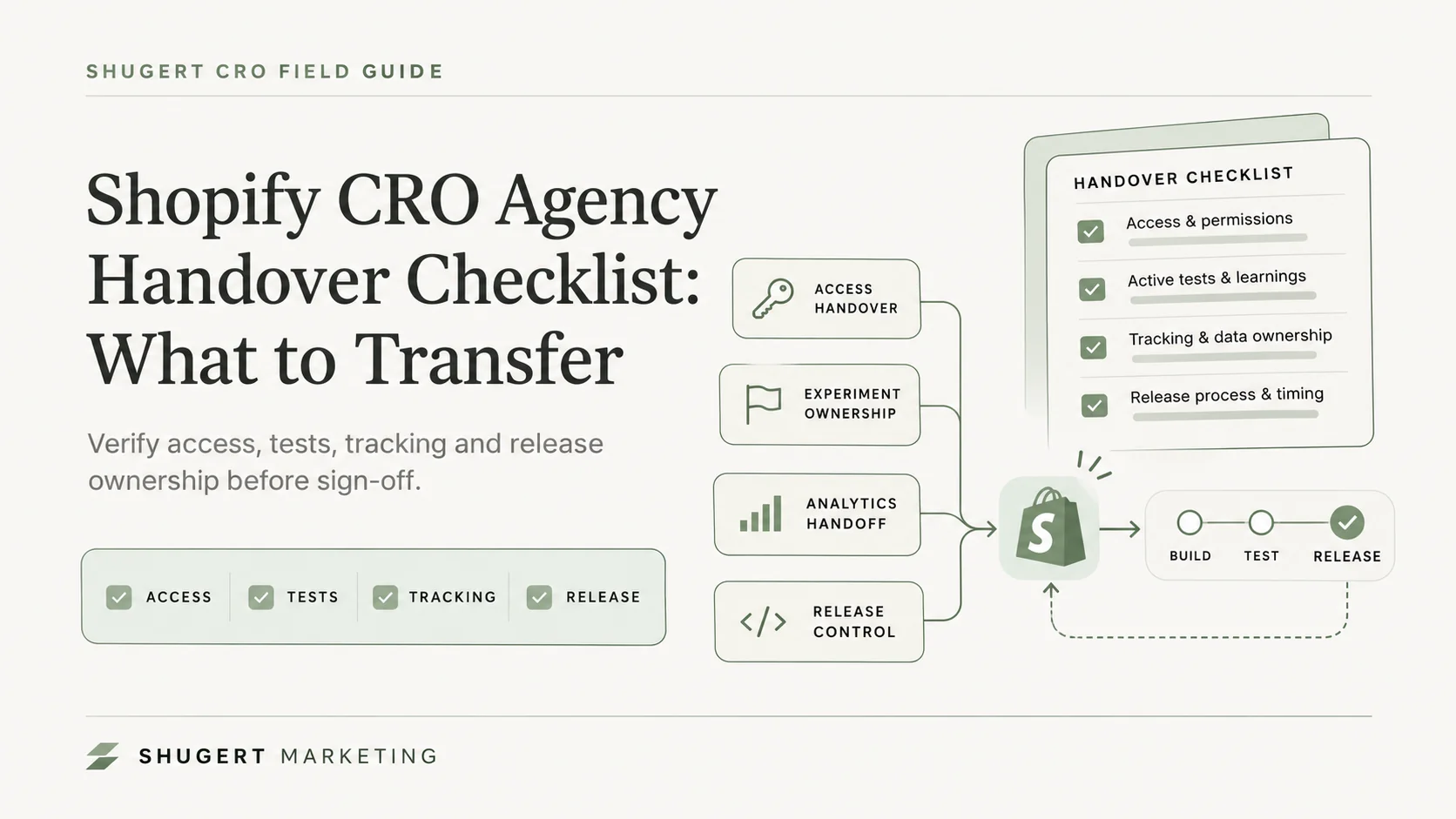
The outgoing agency has sent a folder, the new team has Shopify access, and the final invoice is waiting for approval. But an experiment is still running, the purchase dashboard has changed, and nobody can confirm whether the live theme matches the repository. Account access hasn't answered the operational questions.
A Shopify CRO agency handover checklist should establish what's live, which results are trustworthy, and who can fix a failure after the outgoing team leaves. For established DTC and B2B merchants, especially after a move from WooCommerce, Magento, BigCommerce or a headless build, that evidence matters more than a completed file transfer.
Want the tests run for you? Our Shopify CRO agency connects analytics, research and senior theme implementation.
Table of Contents
- Handover Checklist to Sign Off Against
- How to Transfer Access Without Sharing Secrets
- How to Reconcile Live Tests, Flags and Custom Code
- Experiment Log Fields That Separate Wins From Unfinished Tests
- Confirming GA4 and Shopify Conversion Tracking Still Works
- URL Redirects and Checkout Accessibility as Acceptance Evidence
- Confirm Continuity Before You Revoke Old Access
Handover Checklist to Sign Off Against
| Handover area | What must transfer | Acceptance evidence | Signing owner |
|---|---|---|---|
| Repositories and theme versions | Merchant-owned repository, deployed theme version, release tags | Deployed theme matches the last tagged commit | Engineering lead |
| Experiment configuration | Test register, feature flags, app embeds, custom snippets | Register reconciled with live theme and testing tool | CRO lead |
| Research and hypotheses | Research notes, backlog, hypothesis documents | Each open item has an owner, status and next step | CRO lead |
| Metric definitions | KPI glossary, event dictionary, attribution assumptions | Definitions approved by the receiving analytics owner | Analytics lead |
| Analysis and dashboards | Analysis files, dashboard exports, reporting templates | Receiving team can open and edit each dashboard | Analytics lead |
| Consent and tracking documentation | Consent behavior, tag inventory, data layer, server-side endpoints | Test orders show expected events and consent states | Technical lead |
| Open incidents and dependencies | Incident log, vendor contacts, app and payment dependencies | Each incident has an owner, each dependency has a renewal date | Project manager |
The project manager should copy this table into the project tracker and mark each row pending, verified or waived. Every waiver needs a written reason, a named approver and an explanation of the remaining risk. Evidence should sit beside the row, not in an unindexed message thread.
Sign-off principle: A row is verified when the receiving lead can reproduce the result without the outgoing agency present, not when someone emails the files.
Require a defined production handoff
A contained fix still needs operational documentation. Shugert Marketing's Scoped Shopify Intervention includes senior technical review, written scope, assumptions and acceptance criteria, one contained implementation, quality assurance, release notes and controlled production handoff. Those documents should accompany acceptance, rather than arrive after the production change.
When choosing a Shopify CRO delivery partner, distinguish general conversion agency selection criteria from Shopify-specific implementation ownership. Shugert combines CRO strategy with theme engineering, analytics validation and controlled production handoffs, so the merchant retains documented assets, reproducible tests and a clear rollback path.
Keep commercial acceptance separate from statistical acceptance. A team can deliver an experiment correctly without establishing a winning result. Conversely, a positive result doesn't excuse missing source files, undocumented tracking or an implementation that nobody can maintain.
How to Transfer Access Without Sharing Secrets
Access is an inventory, not a password handover. Shugert Marketing requires clients to grant appropriate access to their Shopify store and related platforms. The merchant should retain ownership while each delivery team receives only the permissions its work requires.
| Platform | Check before transfer | Revoke condition |
|---|---|---|
| Shopify admin | Staff accounts and roles, app permissions, publishing rights | Remove agency staff after continuity is verified |
| Theme source control | Merchant-owned repository, branch and deploy rights | Remove agency write access after the final tagged release is confirmed |
| Testing tool | Project owner, editor seats, API keys held in the merchant vault | Disable agency seats after running tests are handed over |
| GA4 property | Merchant-owned property, administrative access and available annotation permissions | Downgrade to viewer after report checks pass |
| Tag manager | Merchant-controlled container, publish rights, approval workflow | Remove publish rights once a merchant approver is named and publishing is verified |
| Consent platform | Merchant-owned account and configuration export | Revoke after consent QA passes |
| Dashboards and BI | Dashboard ownership and data source credentials | Transfer ownership before removing access |
Follow a controlled transfer sequence
- Inventory accounts. Record every system, account identifier, current owner, billing contact and integration dependency so nothing transfers blind.
- Confirm merchant ownership. Verify the owner of record and recovery contact. An agency-controlled recovery email can undermine otherwise correct permissions.
- Create named users. Assign least-privilege roles to receiving staff instead of recycling shared accounts.
- Move secrets securely. Transfer credentials through a secure channel into the merchant's secrets vault. Passwords and API secrets don't belong in email, spreadsheets or handover documents.
- Exercise permissions. Have each receiving user perform the required action, such as publishing a container, exporting results or editing a dashboard.
- Retain continuity access. Keep explicitly approved outgoing access until the final operational checks pass.
Before disabling any agency seat, export experiment history, results and analytics reports to merchant-owned storage. Confirm that retained tool users can still see the history after the seat is removed.
The monitoring plan should name which permissions remain temporarily and their expiry conditions. Someone on the receiving side must retain the ability to repair a broken publish, not merely view its consequences.
How to Reconcile Live Tests, Flags and Custom Code
Hypothetical scenario: An undocumented Liquid condition keeps serving an old variant after the testing tool is disabled. Nobody notices for two weeks because the dashboard stops updating instead of displaying an error. The experiment has ended administratively, but its storefront behavior remains live.
That mismatch can arise when a test spans the testing platform, theme conditions, app embeds and custom snippets. Disabling the platform doesn't necessarily remove the other implementation layers.
Reconcile behavior against the register
- Export active and paused configurations. Include experiments, targeting rules, feature flags, allocation settings and scheduled changes from the testing tool.
- Inspect the live theme. List enabled app embeds, custom snippets, template conditions and scripts that can alter exposure or page behavior.
- Compare deployment with source control. Record every difference between the deployed theme and the approved release, including direct Shopify editor changes.
- Map each difference. Every live modification needs a register entry with an owner, start date, purpose and code reference.
- Flag unresolved items. Mark orphaned code, unowned flags, unexplained exclusions and experiments without an end condition.
- Approve removal explicitly. Remove nothing until the register matches the site and a decision owner signs the proposed cleanup.
A source comparison alone isn't sufficient. The engineering lead should also exercise the affected customer paths because app configuration can change behavior without changing the theme repository.
A paused testing tool and a live theme condition are different states. Acceptance requires checking what visitors actually receive.
Separate cleanup from new development
The receiving team should isolate reconciliation work from redesigns or new hypotheses. Combining cleanup with fresh functionality makes rollback harder and obscures which change caused a regression.
Where discrepancies require Shopify development work, the implementation ticket should identify the existing behavior, intended replacement, affected templates and rollback route. Before closing the register, the CRO lead should confirm whether any paused experiment still changes visitor experience, including account-specific or market-specific conditions.
Experiment Log Fields That Separate Wins From Unfinished Tests
| Field | What it must contain | Why the next team needs it |
|---|---|---|
| Hypothesis | Change, expected effect and reason | Separates an idea from a random change |
| Owner | Named decision-maker and result approver | Preserves accountability after departure |
| Audience and exclusions | Segments, devices, markets and excluded traffic, including staff | Defines where findings apply |
| Randomization unit | Visitor, session or account, plus assignment method | Prevents mixing incompatible units |
| Variants and code references | Control, variants, theme branch, commit or snippet ID | Locates the changed implementation |
| Start and end time | Exact dates, time zone and traffic pauses | Aligns analysis with exposure |
| Primary metric | A single decision metric and definition | Prevents retrospective metric switching |
| Sample-size assumptions | Baseline, minimum detectable effect, power and traffic estimate | Identifies underpowered results |
| Stopping rule | End date or sample target and early-stop conditions | Limits false positives from peeking |
| Guardrail metrics | Measures that must not worsen, including checkout errors or page speed | Detects harmful trade-offs |
| Implementation changes | Production release, rollback steps and cleanup owner | Establishes what's live and reversible |
| Final analysis | Results, confidence level, segments checked and validation gaps | Separates reviewed evidence from charts |
| Status and follow-up | Running, stopped, inconclusive, rejected or adopted, plus next action | Identifies unfinished work |
An unreviewed before-and-after chart isn't a proven win. Without recorded sample-size assumptions, the receiving analyst can't reliably distinguish insufficient evidence from a result consistent with no meaningful effect.
Use statuses as decision rules
- Running: Exposure continues under the recorded design, with an owner and stopping rule.
- Stopped: Exposure ended, but the decision remains unresolved. Record why it stopped and who completes analysis.
- Inconclusive: Evidence doesn't support a decision. Identify insufficient sample, implementation changes or another validity problem.
- Rejected: The change wasn't adopted. Retain the reasoning so the backlog doesn't accidentally recycle it.
- Adopted: Final analysis is approved, production implementation is confirmed, and a named follow-up has been scheduled.
The analyst should check whether an apparent winner holds across relevant devices, markets, B2B pricing flows, subscriptions and accelerated checkout paths. Sparse subgroup results should remain qualified, not become broad claims about all customers.
Overlapping experiments need de-duplication or documented interaction handling. Each adopted change also needs a code-cleanup owner and an agreed winner-monitoring window. The Shopify A/B testing methodology guide provides the broader analysis context; the handover record must preserve the actual method used, including its uncertainty.
Confirming GA4 and Shopify Conversion Tracking Still Works
Before judging another test, the receiving analytics owner needs a baseline covering sessions, product-view rate, add-to-cart rate, checkout-start rate, purchase conversion rate and revenue per visitor. Include device split, browser, geography, new versus returning users, and B2B versus DTC where applicable. Each KPI needs its event definition, trigger, payload, consent behavior, deduplication rule and reconciliation method.
Checkout usability research identifies design and flow as potential sources of cart abandonment. Shugert separates reproducible storefront friction from instrumentation defects before treating any observed conversion change as an experiment result.
| Check | Scope | Pass evidence |
|---|---|---|
| Product view | Desktop and mobile, consent granted and denied | Expected item data and delivery or suppression consistent with documented consent behavior |
| Add to cart | Desktop and mobile, consent granted and denied | Controlled additions match expected events under each consent state |
| Checkout start | Desktop, mobile and accelerated checkout | Expected event per entry, without refresh-driven duplication |
| Purchase | All payment methods, discount codes and refunds | Transaction ID, value and currency reconcile to the order; no duplicate purchase delivery; refunds validated separately |
| Redundant trackers | Every pixel and server-side endpoint | Complete inventory, with duplicate delivery sources disabled |
| Dashboards and publishing rights | Receiving analytics owner | Owner can publish where applicable, edit and export each dashboard |
Reconcile controlled orders, not just totals
Run controlled orders through Shopify and inspect available GA4 debug tools. Include successful and failed payments, subscriptions, accelerated checkout, cancellations, refunds, tax or shipping changes and cross-domain payment paths.
Consent-denied sessions shouldn't automatically produce the same observable events as consent-granted sessions. The pass condition is the approved consent design, not maximum event volume.
Measurement acceptance: Agree reconciliation tolerances before reviewing the results. Exact equality between reporting systems isn't a sensible universal requirement.
GA4 and Shopify can differ because of attribution, time zones, consent and reporting definitions. Document those differences and compare Shopify orders with applicable payment-provider records rather than dismissing every discrepancy as normal.
A checkout-start decline could reflect tracking, traffic mix or actual friction. An unexplained tracking defect discovered during acceptance is a handover failure, not a reporting quirk.
URL Redirects and Checkout Accessibility as Acceptance Evidence
The receiving technical lead should obtain the approved old-to-new URL map and final redirect file. Each legacy address needs a relevant destination and an expected response, not merely a checkmark showing that a redirect exists.
Shopify's Plus launch checklist treats 301 redirects as a prelaunch task because unredirected legacy URLs can return 404 errors. Verify priority product, collection, editorial, account, campaign and discontinued-product URLs in both a browser and a crawler, retaining the results as acceptance evidence.
Google Search Central's site-move guidance recommends server-side permanent redirects, generally maintained for at least one year, and warns against redirecting unrelated legacy pages to a single destination such as the homepage. Record destination relevance, canonical tags, XML sitemaps, robots directives, analytics annotations and monitoring ownership alongside the map.
Test the complete checkout process
W3C's WCAG 2.2 Recommendation announcement dates Recommendation status to October 5, 2023. Its conformance framework requires every page in a multipage process, including checkout, to conform when that process is included in the conformance claim.
That means homepage and product-template checks aren't enough. The acceptance record should cover:
- Process states: Cart, customer information, shipping, payment, errors, confirmation, account, promotional and post-purchase interactions.
- Interaction evidence: Keyboard navigation, visible focus, form labels, understandable errors and screen-reader announcements.
- Presentation checks: Contrast, zoom and reflow, including content or controls obscured at enlarged settings.
- Limits and remediation: Target WCAG level, third-party checkout constraints, documented exceptions, supporting evidence and named remediation owners.
A limitation imposed by an app doesn't disappear because the merchant can't edit its code. The receiving lead still needs the affected path, customer impact and escalation contact.
Keep accessibility findings distinct from conversion hypotheses. A blocked payment interaction needs remediation and verification, not a speculative experiment designed to establish whether removing the barrier improves revenue.
Confirm Continuity Before You Revoke Old Access
Before access changes, the receiving lead should answer every acceptance question yes or no, without help from the outgoing team:
- Release control: Can the lead rebuild or deploy from source control alone?
- Live configuration: Does the experiment register match live tests, app embeds and snippets?
- Measurement: Is reconciliation within the agreed tolerance, with evidence separating experiment results from tracking faults?
- Customer paths: Is redirect and checkout accessibility evidence on file?
- Incident ownership: Does every open incident have an accountable owner?
- Dependency continuity: Does every app, vendor contract, payment provider and consent platform have a renewal date or explicit nonrenewing status?
Only affirmative answers close the handover. A waiver authorizes continued operation; it does not establish verified evidence.
Set the monitoring and revocation plan
Shugert Marketing monitors Search Console, analytics and orders through the first 30 days after migration cutover, as covered in its Shopify migration plan. Agree monitoring ownership and acceptance conditions using the migration cutover guide.
Once monitoring shows no continuity gaps, revoke publishing rights first, editor seats next and read-only access last. Retain the evidence needed to distinguish proven wins from unfinished tests.
Speed-focused fixes for stores losing performance after theme and app changes cost $2,500 to $4,000. Monthly Shopify support starts at $1,495. Broader migration and custom development projects start at $5,000, with timelines of 4 to 24 weeks. An isolated handover defect doesn't automatically justify a rebuild.
Request a written migration and handover scope from Shugert Marketing with the current platform, unresolved dependencies and experiment register attached. Specify acceptance criteria, required evidence and an owner for each.
Turn more of your existing traffic into orders
Milas Keeper came out of the engagement with cleaner product pages and a more usable mobile shopping experience. Read the case study
Most quotes returned within 1 business day