Shopify Post Migration Indexation Monitoring: 7 Tools
A post-launch checklist for Shopify post migration indexation monitoring: the tools, checks and escalation triggers that protect rankings after cutover.
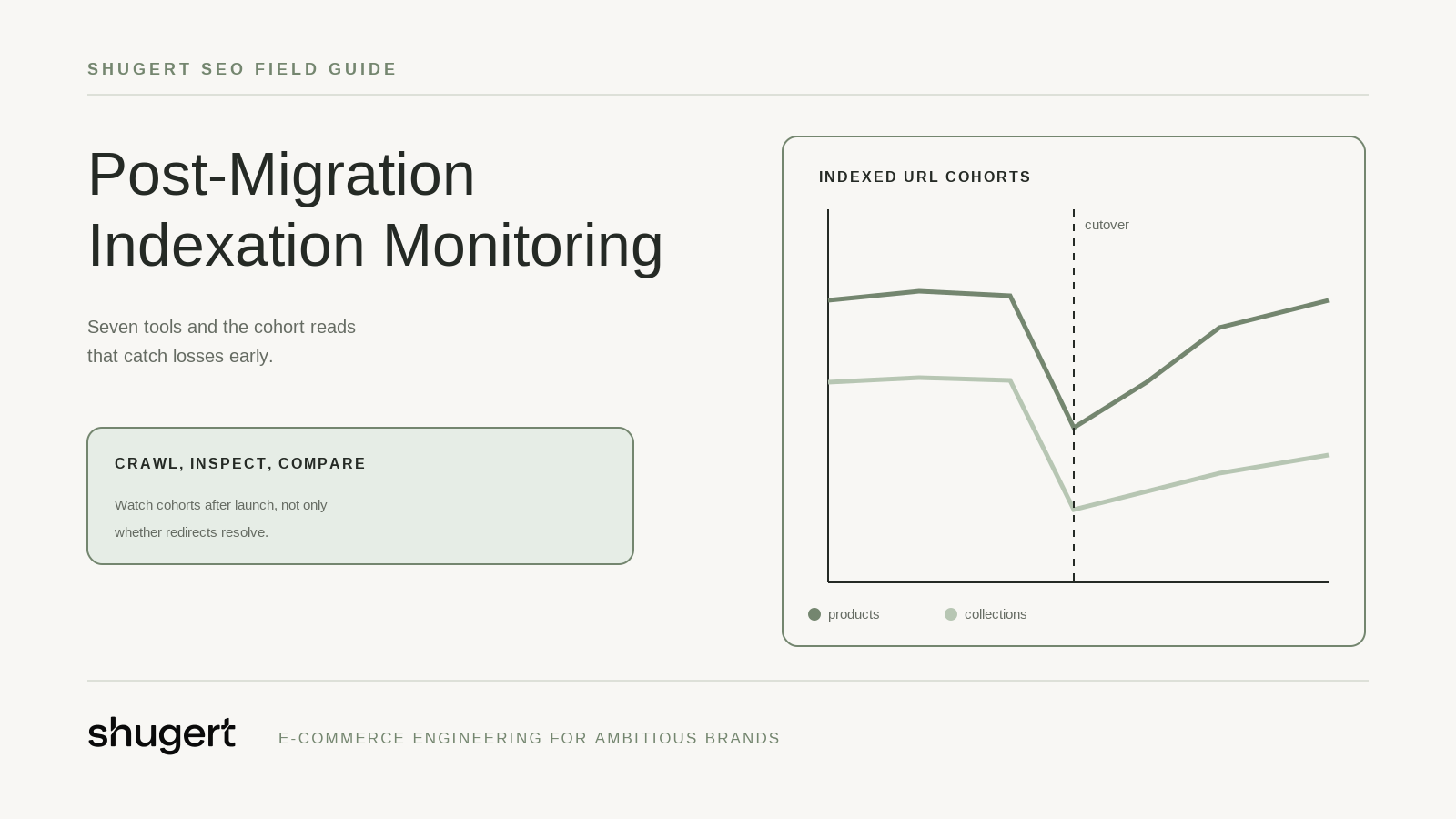
A successful HTTP response isn't proof of an indexed page. Google's site-move guidance describes migration progress as old indexed URLs declining while new indexed URLs increase, not redirects resolving alone. Even that aggregate transition can hide losses across priority products, collections, or locales.
Shopify post migration indexation monitoring needs evidence that priority legacy URLs reach approved, relevant destinations; final pages have intended rendered indexability and canonicals; and submitted canonical URLs and internal links match the migration map. During the first month, incomplete fresh Search Console data shouldn't automatically be classified as traffic loss. Unintended noindex, canonical divergence, redirect loops, important missing pages, and sustained cohort losses against baseline and seasonality deserve escalation.
Launch decisions belong in public-production migration QA. Implementation belongs in the 301 redirect guide, while the Shopify migration fundamentals guide and this broader website migration SEO checklist cover upstream planning. The tools below serve a narrower purpose: observing production, separating delayed reporting from actual defects, and assigning fixes.
Planning a replatform? Our Shopify migration service moves products, customers, orders and redirects as one SEO-safe scope.
Table of Contents
- 1. Google Search Console
- 2. JetOctopus
- 3. Ahrefs Site Audit
- 4. Little Warden
- 5. SEOTesting
- 6. Screaming Frog SEO Spider
- 7. Conductor Monitoring
- Post-migration indexation monitoring tools compared
- Build Your Stack, Set Your Escalation Triggers, Then Watch the Cohorts
1. Google Search Console
Best for establishing what Google knows about migrated URLs. Google Search Console belongs in every monitoring stack, regardless of catalog size or crawler budget. Its Page indexing, Sitemaps, URL Inspection, and Search performance reports answer different questions and shouldn't be treated as interchangeable.
Start with a saved baseline export and a migration URL ledger. Each record should connect the legacy URL, approved Shopify destination, page type, locale, commercial priority, and expected indexing outcome. Where the domain changes, verify the relevant properties separately.
Use cohorts instead of a storewide score
Submit the Shopify sitemap at /sitemap.xml, then investigate priority destinations rather than celebrating an accepted submission.
- Page indexing: Separate unintended exclusions from expected duplicate, retired, or nonindexable URLs.
- URL Inspection: Compare the declared canonical with Google's selected canonical and inspect priority destinations individually.
- Search performance: Track clicks and impressions for mapped product, collection, editorial, and locale cohorts.
- Live testing: Check corrected production pages rather than assuming the indexed snapshot reflects the latest deployment.
Google's URL Inspection documentation supports testing a corrected live URL before requesting indexing. That's useful for high-value exceptions, not a replacement for catalog-wide crawling.
Trade-off: Search Console provides Google's view, but it doesn't continuously validate the production store. Reporting delays and inspection limits make it unsuitable as the only incident detector.
A documented Shopify migration scope should assign ownership for this reporting separately from ownership of technical fixes. Otherwise, teams can identify an exclusion without anyone investigating its cause.
2. JetOctopus
Large catalogs need pattern detection more than another spreadsheet of isolated errors. JetOctopus combines cloud crawling with Search Console and analytics integrations, making it a candidate when product, collection, and locale cohorts are too large for comfortable manual review.
Its useful migration role is joining technical state with commercial exposure. A canonical change affecting an unimportant duplicate isn't equivalent to the same change affecting an established wholesale landing-page cohort.
Compare the same crawl scope
Configure comparable production crawls with consistent rendering settings, inclusion rules, and URL normalization. A changed crawl configuration can otherwise look like a migration regression.
Useful comparisons include:
- Discovery gaps: Approved destinations present in the migration ledger but absent from the internal crawl.
- Template changes: New noindex directives, canonical shifts, or response failures concentrated in a page family.
- Commercial exposure: Affected URLs with historical search demand or analytics activity.
- Rendering differences: Products reachable only after JavaScript execution versus products discoverable through ordinary links.
What works: A shared workspace helps engineers investigate cohort-wide changes without repeatedly joining separate exports. JavaScript crawling is particularly relevant when collection grids or custom storefront components affect discovery.
What doesn't: A crawler's indexability assessment still isn't Google's indexing decision. An alert should open an investigation, not automatically trigger a sitemap resubmission.
JetOctopus can also be more platform than a temporary, single-store monitoring effort needs. Shopify log access and the supported ingestion method require explicit vendor confirmation before log analysis becomes part of the operating plan. A crawler integration doesn't establish that usable origin logs are available.
3. Ahrefs Site Audit
An existing Ahrefs subscription can make Ahrefs Site Audit a practical monitoring choice without adding another reporting environment. Its scheduled auditing and Always-on audit capabilities are relevant when production changes continue after cutover.
The strongest use case isn't proving indexation. It's detecting new technical regressions between deliberate audit runs, especially while theme releases, merchandising updates, and app changes continue.
A technical alert identifies a changed condition. The migration ledger establishes whether that condition violates the intended outcome.
Turn alerts into reproducible tickets
An alert needs the affected URL, previous state, current state, deployment context, and business cohort. Without those fields, engineers receive an issue count rather than a testable problem.
For a canonical alert, the ticket should distinguish the HTML declaration from Google's selected canonical. For a redirect alert, it should capture the legacy request and final destination, not just the destination's availability.
Advantages: Teams already using Ahrefs for backlinks and search research can investigate technical issues alongside evidence of URL importance. Issue history also helps separate launch defects from changes introduced later.
Limitations: Always-on coverage, alert behavior, crawl acceleration, and project entitlements should be checked against the current subscription. Faster crawling isn't automatically better if it produces more alerts than the team can investigate.
For automated inspection alongside crawl findings, Google's URL Inspection guidance distinguishes indexed information from live testing. Automation should preserve that distinction and respect inspection quotas, rather than labeling every crawlable page as indexed.
4. Little Warden
A small watchlist can catch a serious regression faster than a broad audit that hasn't run yet. Little Warden fits that role by monitoring configured URLs and technical conditions such as redirects, robots changes, and indexability signals.
A useful Shopify watchlist includes legacy landing pages, their approved destinations, important collections, representative product templates, and critical B2B or locale pages. The selection should reflect commercial risk and shared template coverage, not just the homepage and best-selling product.
Watch paired legacy and destination URLs
Monitoring only the new page misses a broken legacy route. Monitoring only the old redirect misses a destination that remains available but acquires an unintended robots directive.
- Legacy checks: Confirm that the expected permanent redirect still reaches the approved relevant destination.
- Destination checks: Watch indexability signals and unexpected canonical or response changes where supported.
- Shared controls: Monitor robots.txt and representative pages affected by theme-level changes.
- Alert routing: Send actionable notifications to the person who can investigate, using supported delivery channels.
The advantage is focus. A targeted monitor can remain useful after the intensive stabilization period ends, particularly for URLs with valuable backlinks or recurring seasonal demand.
The limitation is coverage. Little Warden monitors the configured set; it doesn't discover every newly orphaned product or report Google's authoritative indexing state. A healthy watchlist can coexist with problems elsewhere in the catalog.
Before purchase, confirm URL allowances, check frequency, alert channels, and the exact signals covered by the selected plan. A low-cost watchlist becomes less attractive if catalog-wide coverage is the actual requirement.
5. SEOTesting
SEOTesting is most useful when the question shifts from “Did production change?” to “Which migrated sections lost search visibility?” Its Search Console-based grouping, annotations, tests, and sitemap or robots monitoring support that transition.
Migration analysis needs groups that reflect decisions, not arbitrary URL buckets. Products consolidated into parent pages should be evaluated differently from products intended to retain individual visibility.
Compare inventories before interpreting performance
Shopify's sitemap guidance treats the sitemap as a discovery resource containing preferred, eligible URLs, not proof that every listed page has been indexed. That makes sitemap changes useful evidence, but incomplete evidence.
Maintain distinct inventories for:
- Approved destinations: Canonical URLs expected from the migration map.
- Submitted URLs: Canonical destinations exposed through the live sitemap.
- Linked URLs: Destinations reachable through navigation, collections, and editorial links.
A removed sitemap entry might be intentional retirement, accidental unpublishing, or a change in canonical eligibility. The monitoring alert alone doesn't establish which explanation applies.
What works: Annotating cutover and subsequent template changes helps analysts interpret cohort-level impressions and clicks. Page groups also make collection or locale losses easier to spot than a storewide traffic chart.
What doesn't: Search Console-based analysis isn't immediate production diagnostics. Sitemap monitoring won't reveal every redirect chain, rendered noindex, or broken product-grid link.
SEOTesting is therefore a strong companion to a crawler, especially when an ecommerce director needs an understandable account of affected sections. It isn't a substitute for inspecting the technical state behind the performance change.
6. Screaming Frog SEO Spider
Screaming Frog is the deliberate investigation tool in this stack. Screaming Frog SEO Spider can crawl the production store or process a supplied list of migration URLs, allowing engineers to test the approved map rather than whatever the navigation happens to expose.
That distinction matters. A normal site crawl can miss an orphaned destination precisely because the internal links are missing.
Run separate mapping and discovery checks
Use list mode for legacy URLs and approved destinations. Capture redirect hops, final responses, canonical targets, meta robots, and relevant response headers. Compare those results with a production discovery crawl to identify destinations absent from the linked site.
A practical investigation sequence is:
- Test the route: Verify the old URL reaches the intended Shopify destination without loops or irrelevant fallbacks.
- Inspect the destination: Check response status, robots directives, canonical output, and rendered content.
- Check discovery: Confirm relevant navigation, collections, or content link to the canonical destination.
- Record the evidence: Save crawl configuration, timestamp, exports, and the affected cohort.
Practical rule: A destination can pass a URL-list crawl and still fail discovery because nothing important links to it.
Trade-off: Detailed control requires an operator who understands crawl scope, rendering, exclusions, and resource limits. Scheduled desktop crawls also depend on an available, correctly configured machine.
The crawler doesn't independently establish Google's indexing decision. Persistent mismatches belong in a technical SEO cleanup investigation, with crawl evidence and Search Console observations kept distinct. Otherwise, a technically corrected page may be incorrectly reported as already reindexed.
7. Conductor Monitoring
Enterprise monitoring becomes relevant when the migration overlaps with ongoing releases, multiple owners, and substantial catalog change. Conductor Monitoring targets continuous technical and content observation rather than occasional crawl snapshots.
Its value depends on operational ownership, not dashboard breadth. A Shopify Plus team needs to know which pages changed, why they matter, and which engineering or merchandising owner should respond.
Evaluate the response workflow
A meaningful evaluation should use representative product, collection, B2B, and locale pages. Include both expected changes and hypothetical failure conditions, clearly separated from actual production incidents.
Assess whether the proposed configuration can support:
- Technical detection: Relevant changes to indexability, responses, canonicals, and shared crawl controls.
- Content governance: Unexpected changes to commercially important product content or page elements.
- Prioritization: Business-critical pages distinguished from low-value duplicates.
- Incident routing: Evidence delivered to the team responsible for the affected template or integration.
Advantages: Continuous observation can reduce dependence on someone remembering to run another audit. Content monitoring can also help distinguish an SEO control problem from a merchandising or publishing change.
Limitations: Public marketing descriptions don't establish that every required check, integration, or alert channel is included in a quoted plan. Pricing, capacity, and deployment requirements need confirmation during evaluation.
For a temporary stabilization effort, Conductor may introduce more procurement and configuration work than a mid-market merchant needs. It becomes more compelling when the organization will retain continuous monitoring after migration, with assigned owners and an established incident process.
Post-migration indexation monitoring tools compared
| Tool | Primary Role | Crawl Coverage | Alerting | Pricing Transparency |
|---|---|---|---|---|
| Google Search Console | Google indexing and search visibility monitoring | Sitemap and URL-level checks; not a continuous site crawl | Google alerts for indexing and other site issues | Free with a verified site |
| JetOctopus | Cloud technical SEO crawling and data integration | Large-site crawling, including JavaScript mode and crawl comparisons | Indexability and Core Web Vitals alerts | Paid plans; pricing may be costly for short-term use |
| Ahrefs Site Audit | Technical SEO auditing and ongoing monitoring | Continuous and scheduled crawling | Email alerts for newly affected pages with critical issues | Paid plans; some faster-crawl features may cost extra |
| Little Warden | Monitoring selected URLs and technical signals | Configured URLs only; not a full-site crawl | Email, Slack, API, and webhook alerts | 40-day free period; higher-volume plans may be costly |
| SEOTesting | Sitemap and robots monitoring with Search Console analysis | Sitemap and robots.txt monitoring; not a full crawl | Alerts for sitemap and robots.txt changes | Public month-to-month pricing |
| Screaming Frog SEO Spider | Desktop crawler for technical and migration QA | Site or URL-list crawling; scheduled crawls and comparisons | No automatic Google indexation alerts | Free version up to 500 URLs; licensed version available |
| Conductor Monitoring | Enterprise technical and content monitoring | Continuous monitoring with plan-based page capacities | Real-time alerts | Dollar pricing not public; sales-led evaluation |
Build Your Stack, Set Your Escalation Triggers, Then Watch the Cohorts
Search Console plus a full crawler is the baseline. Export the pre-launch baseline before cutover, then use a crawler to compare templates, canonicals, redirects and indexable status against the approved map. Little Warden or SEOTesting fits targeted watchlists and change tracking. JetOctopus, Ahrefs or Conductor earns its cost when catalog scale, existing subscriptions or release complexity creates more URLs than manual checks can hold.
During initial cutover, run technical blocker checks daily. Review priority product, collection, B2B and locale cohorts several times weekly while the store stabilizes, because a healthy sitewide graph can hide a broken template inside one high-value group. Shugert Marketing monitors Search Console, analytics and orders through the first 30 days after cutover.
Escalate defects, not reporting gaps
Immediate investigation is appropriate for unintended noindex, canonical divergence, redirect loops and important missing pages. Sustained cohort losses require comparison with the saved baseline, seasonality, tracking integrity and the migration's intended retirements.
- Retained staging noindex: Inspect rendered meta robots, the HTTP X-Robots-Tag and robots access on affected production templates.
- Configuration correction: Remove the unintended rule at its source, then test representative production samples.
- Discovery repair: Align internal links and submitted canonical URLs with the approved map.
- Subsequent processing: Use URL Inspection after correction without promising a recrawl or indexing deadline.
Some retired and duplicate pages should leave the index. Their disappearance isn't automatically a migration failure.
Processing depends on crawl demand, scale and page quality. Google's site-move workflow calls for monitoring old and new URLs through the transition, so redirects resolving or a sitemap being accepted is only the start of the review.
Commercial planning should separate stabilization work from the full replatform. Shugert Marketing's migration and custom development projects start at $5,000, are fixed-price for the approved scope, run 4 to 24 weeks, and monthly support starts at $1,495. Those are project terms, not indexing recovery promises.
Teams planning a cutover or investigating post-launch cohort losses can request a migration scope with the legacy URL export, approved redirect map, Search Console baseline and affected product, collection or locale groups.
Migrate without losing rankings
Llantas Cavazos moved 8,000+ SKUs in under 7.5 weeks and kept 90%+ of organic traffic in week one. Read the case study
Most quotes returned within 1 business day