Shopify B2B Data Migration Validation: What Counts Miss
Shopify B2B data migration validation goes beyond record counts. Test company locations, catalogs, prices, terms and ERP orders before launch.
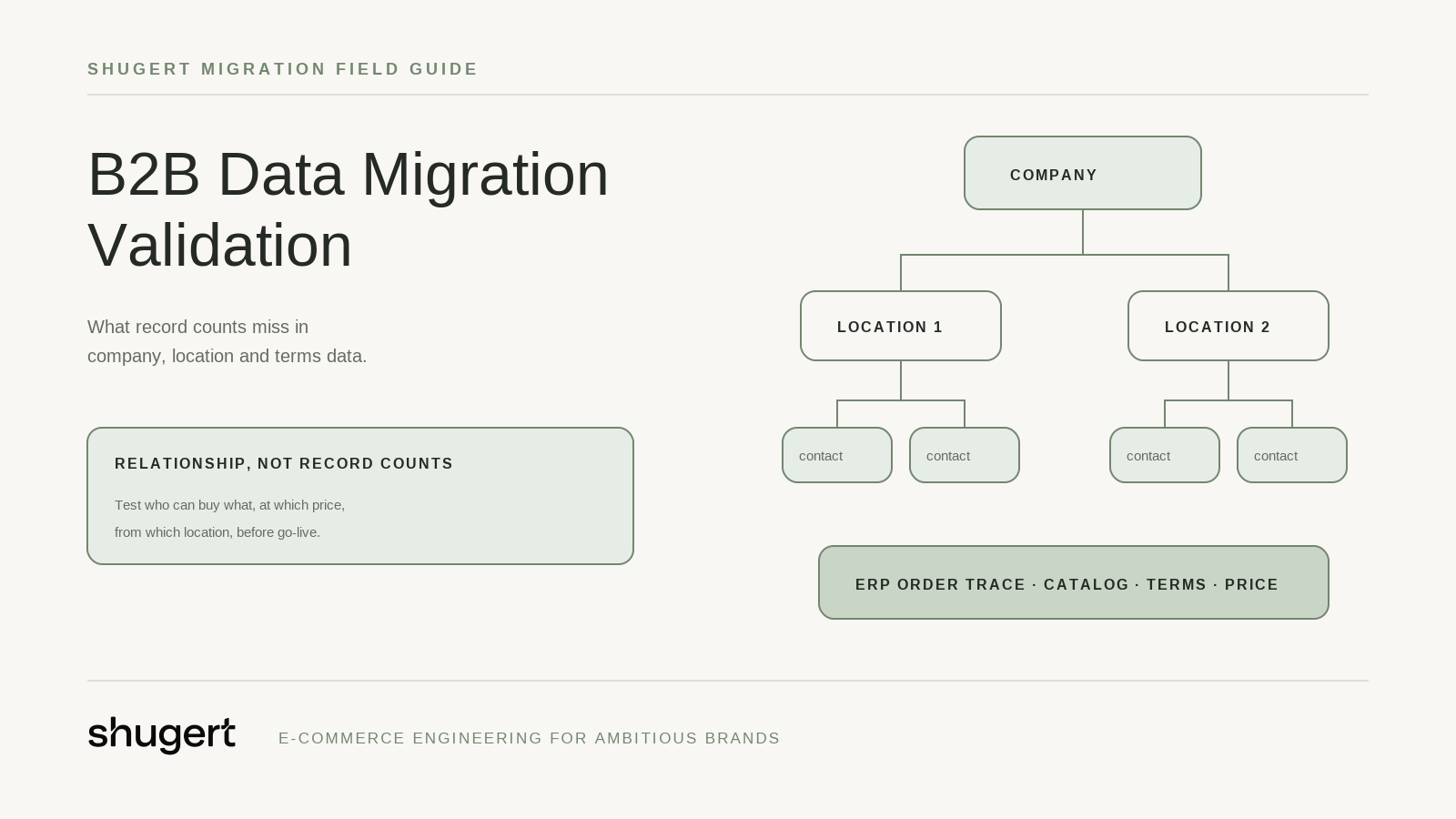
A matching import count is one of the weakest reasons to approve a B2B migration. Products and customers can arrive intact while buyers inherit the wrong catalog, purchasing permissions, or payment terms. Shopify B2B data migration validation should prove what each buyer can see and do, not just whether records exist.
For established merchants moving from WooCommerce, Magento, BigCommerce or a headless build, the acceptance unit is the buyer's commercial relationship: company, location, contact, entitlement and resulting order. A successful import is necessary. It isn't launch approval.
Planning a replatform? Our Shopify migration service moves products, customers, orders and redirects as one SEO-safe scope.
Table of Contents
- Validation Checks That Go Beyond Record Counts
- How to Map Company, Location and Contact Records
- Testing Catalogs, Prices and Terms by Location
- Negative Access Tests and Protecting QA Data
- Deciding Which System Owns Each Value After Launch
- Tracing a Controlled Order Through Your ERP
- Go or No-Go Evidence for Launch Sign-Off
- Request a Migration Scope Before Cutover
Validation Checks That Go Beyond Record Counts
Hypothetical example: All 1,200 contacts import, every count matches, but 60 contacts link to the wrong company location. Those buyers can sign in, yet they see another location's prices and payment terms. The migration passes a spreadsheet check and fails the purchasing agreement.
The stakes are transactional, not cosmetic. In 2024, 81% of surveyed professional B2B buyers reported significant barriers caused by outdated systems and inaccurate data, according to Sana Commerce's 2025 B2B Buyer Report, based on SAPIO Research. An incorrect location assignment can affect what a buyer orders, what finance invoices and which team must correct the transaction.
Totals prove that data arrived. Relationship and permission tests prove that buyers see the right data.
Validation checks by entity
| Entity | Count check | Relationship check | Acceptance evidence |
|---|---|---|---|
| Companies | Count and unique external IDs match source | Each company maps to one approved source ID | Signed ID map |
| Company locations | Count per company matches source | Each location links to its own tax, terms and catalog assignment | Location-level sample with field values |
| Contacts | Count per location matches source | Each contact belongs to exactly one intended location and role for the tested assignment | Exception log with named owner |
| Catalogs and price lists | Assignment count matches source | Each location maps to the approved catalog and currency | Price comparison against source contract |
| Payment terms and tax status | Non-null count matches source | Terms and exemption values match contract data | Business owner sign-off |
| Products and variants | SKU and variant totals match by batch | Each intended variant sits in the correct catalog and is published | Batch reconciliation report |
| Historical orders | Order count and totals per period match | Each order links to the correct customer and location | Finance reconciliation |
The contact check applies to each approved assignment, not a blanket prohibition on multi-location buyers. A buyer authorized for several branches needs an explicit set of relationships. Duplicate email addresses or familiar company names aren't sufficient evidence of authorization.
Reviewers should sign evidence with expected and actual values side by side. A screenshot showing that a company exists doesn't establish which source account it represents, which location owns the terms or whether a buyer can order.
Field normalization and import mechanics belong in the broader Shopify data migration fundamentals. For a replatforming scope, the Shopify migration engagement should identify relationship testing separately from record transfer, so acceptance doesn't default to an import-success message.
How to Map Company, Location and Contact Records
Companies, locations and contacts are separate objects. A valid contact record can still have an invalid purchasing relationship, particularly when legacy systems mix corporate account IDs, branch codes and billing accounts in the same field.
In 2025, 67% of B2B ecommerce practitioners identified system compatibility as an integration challenge, while 63% cited maintaining data consistency across tools, according to Master B2B's 2025 State of B2B eCommerce Report. Mapping needs to resolve those differences before a connector or import script makes them harder to inspect.
Build an approved relationship map
Export stable source identifiers. Capture every company, location and contact ID, then assign a unique external key within each entity type. Names and email addresses can change, so they shouldn't replace durable identifiers.
Map each contact-to-location assignment and its intended role. Flag people attached to several companies or branches for a business decision rather than collapsing their access into whichever record imports first.
Attach commercial values to the location. Map tax exemption, payment terms, currency context and shipping site to the approved branch relationship. A corporate default must not overwrite a negotiated branch exception.
Map each location to its intended catalog or price-list context, not merely to the parent company. Record the mechanism the target store will use to apply that entitlement.
Store Shopify global IDs beside source IDs. Keep the relationship crosswalk in a controlled sheet or equivalent register with an approver and revision history. Subsequent loads should resolve existing objects through that crosswalk rather than creating replacements.
Load deterministic batches and route rejected or ambiguous rows into an exception log. Each exception needs a named owner, a reason and a disposition, not an unexplained exclusion from the next export.
Rerun relationship checks after each batch. Require no unexplained unlinked contacts, orphan locations or unauthorized assignments before advancing. Compare expected assignment sets, because a contact with an extra relationship can be as problematic as a missing one.
Separate identity from account communications
A signed map should distinguish the customer's identity, company-contact relationship and location permissions. Combining them into a single customer row makes branch access difficult to audit and encourages accidental duplication.
The cheapest import approach may use a manually reviewed crosswalk. A more automated pipeline costs more to implement but becomes worthwhile when repeated rehearsals and delta loads would otherwise require staff to rebuild the same decisions.
Customer passwords cannot move to Shopify. Shugert Marketing plans the timing and wording of account invitation emails as part of cutover; the recipient list must come from approved contact mappings. The team should confirm the target account experience before describing activation steps, because an invitation must match the store's actual sign-in flow rather than promise a legacy password will work.
Testing Catalogs, Prices and Terms by Location
A buyer fixture is a synthetic account with a known company, location and permission assignment. The fixture set should represent commercial differences, including a multi-location company and a branch with an exception to standard pricing, rather than merely sampling the largest accounts.
Before testing, finance or the commercial owner records each expected result from the approved contract. Testers then compare that expectation against the authenticated storefront, cart and resulting order. Copying the imported Shopify value into the expected-results column would test consistency with the import, not correctness against the agreement.
Buyer fixture test matrix
| Test case | Fixture setup | Expected result | Compare against |
|---|---|---|---|
| Assigned catalog visibility | Logged-in buyer at location A | Only location A's entitled catalog products appear | Catalog assignment export |
| Fixed variant price | Buyer on a fixed price list | Storefront and cart show the contract price | Signed price file |
| Percentage adjustment | Location with a percentage discount rule | Price equals base price minus the agreed percentage, rounded per rule | Approved rounding policy |
| Quantity and case-pack rules | Case-pack variant at minimum quantity | Cart rejects quantities that break the case pack | Product rule export |
| Currency | Non-USD location, if enabled for the store | Prices and totals display in the contract currency | Market configuration record |
| Tax treatment | Tax-exempt location and taxable location | Exemption applies only where approved | Tax certificate record |
| Payment terms | Hypothetical net 30 location, where terms are enabled | Terms option offered and recorded on the order | Payment terms export |
Shopify's B2B developer documentation describes companies, locations, contacts, catalogs and price lists as related components, including fixed variant prices and percentage adjustments. Feature eligibility must be confirmed for the selected plan and configuration before fixtures are approved. Teams shouldn't assume every B2B capability universally requires Shopify Plus, or that every assignment mechanism is available on every plan.
Compare outcomes, not configuration screens
For each fixture, preserve the source contract reference, target location ID, variant ID, quantity, expected price and actual total. Test a boundary quantity as well as a valid case-pack quantity. A rule that appears in an export but doesn't prevent an invalid purchase hasn't passed.
The customer-specific B2B pricing fundamentals explain the pricing structures. Migration acceptance needs the narrower proof that the agreed structure applies to the intended buyer.
Require zero unexplained mismatches. Any rounding or tax tolerance must be approved in writing before execution, with its calculation basis recorded. A tolerance for currency rounding must not become permission to accept the wrong contract price.
Negative Access Tests and Protecting QA Data
The most damaging access defect may be a buyer successfully ordering under an agreement that doesn't belong to that buyer. Positive tests won't expose it: an authorized account can complete every intended action while an unauthorized account can complete those actions too.
Hypothetical example: A Location B buyer opens a Location A-only product URL, submits its variant to the cart and attempts checkout using Location A's terms. For a configuration requiring strict separation, the expected result is no restricted product visibility, rejection of the unauthorized cart item and no access to Location A's terms.
Test denied actions explicitly
Create fixtures for the permission classes the implementation supports, such as buyers, ordering staff and approvers. These are business roles to validate, not a promise that Shopify supplies every role or approval workflow natively. Confirm supported account permissions and any app or custom enforcement before assigning expected results.
Rerun a fixed negative suite after each relationship-changing load:
- Cross-location access: Attempt to select an unassigned branch and retrieve its commercial information.
- Direct product access: Open restricted product URLs without navigating through the catalog.
- Cart submission: Submit a restricted variant directly, including through any custom ordering interface.
- Terms escalation: Attempt to use another location's payment arrangement.
- Role escalation: Try an ordering or approval action outside the fixture's approved permission set.
- Revoked access: Remove an assignment and verify that the buyer loses access, including in an existing session.
Logged-out testing needs its own expected policy. In a blended store, anonymous visitors may see public retail products, but they must not receive private company prices or terms. In a dedicated wholesale store, the approved public experience may be more restrictive.
Security gate: Hiding a button isn't authorization. Restricted actions must remain blocked when submitted directly.
Keep QA evidence reviewable without exposing buyers
Use synthetic names, emails and addresses wherever possible. When production-derived exports are necessary, mask personal fields while retaining stable pseudonymous keys for relationship comparisons.
Limit access to QA extracts, separate credentials from evidence files and define when reviewers must delete downloads. An exception log usually needs an object identifier and mismatch description, not a buyer's complete address or tax document. Preserve enough evidence to reproduce a failure without turning the sign-off package into an uncontrolled customer database.
Deciding Which System Owns Each Value After Launch
Values can be valid in separate systems and still disagree operationally. Shopify's B2B ERP integration guidance identifies products, pricing, inventory, customers, orders, fulfillment and financial data as integration domains, with sync direction, frequency and transformations requiring explicit decisions.
The following register is hypothetical, not a recommended universal architecture.
| Value | Authoritative system | Sync direction | Sync frequency |
|---|---|---|---|
| Product descriptions | PIM | PIM to Shopify | Approved publication |
| Contract pricing and terms | ERP | ERP to Shopify | Approved contract change |
| Sellable inventory | WMS | WMS to Shopify | Stock event |
| Customer account codes | ERP | ERP to Shopify | Account approval |
| Submitted orders | Shopify | Shopify to ERP | Order submission |
| Fulfillment status | WMS | WMS through ERP to Shopify | Shipment event |
| Financial balances | ERP | ERP to reporting | Posting event |
Hypothetical failure: An ERP changes a company's net terms, but its Shopify location retains the old agreement. The buyer checks out on terms finance no longer honors.
One system owns each field. Other systems receive it through a documented sync.
Record currency rounding, units of measure and status-code transformations. Then change a value in the non-owning system and confirm rejection or overwrite follows the contract. Test retry and conflict behavior for order status, inventory and customers, particularly after partial failures.
Tracing a Controlled Order Through Your ERP
A controlled order proves that commercial meaning survives every system boundary, not just Shopify checkout. Shopify's ERP migration guidance calls for bidirectional synchronization and order-lifecycle testing, including returns and partial shipments. For migration validation, that means checking identifiers, quantities and financial values together.
Hypothetical B2B order test matrix
| Test | Shopify action | Pass condition | ERP check |
|---|---|---|---|
| Case pack versus single unit | Order a case pack and a single unit | Quantity and unit price follow the pack rule | Pack quantity and unit cost match |
| Customer and account ID | Order from a multi-location company | Same external account ID and location code | ERP account matches mapping sheet |
| Location-specific price | Order from a location on a fixed price list | Line price equals contract price | ERP line price and discount match |
| Tax treatment | Order from exempt and taxable locations | Tax applies only where approved | ERP tax code and amount match |
| Currency | Non-USD order, if enabled | Totals display in the contract currency | ERP currency and conversion rate match |
| Payment terms | Order on net terms | Terms recorded on the order | ERP invoice due date matches |
| Fulfillment site | Order routed to another warehouse | Checkout promise, where shown, matches routing | ERP fulfillment site matches |
| Retry after timeout | Force an ERP timeout after acceptance | No duplicate order created | Unique ERP order for the correlation ID |
| Cancellation and refund | Cancel an order and partially refund another | Reversed obligations close; retained balance remains correct | ERP and payment records reconcile |
Place each order from its fixture account. Record the Shopify order ID and a correlation ID that middleware carries into the ERP, then compare account, location, price, tax, currency, terms and fulfillment site against the expected record.
For timeout testing, interrupt acknowledgement after the ERP accepts the order. A timeout before acceptance doesn't test the difficult duplicate scenario. The retry must find or safely reuse the accepted transaction rather than create another order.
A cancellation should close the cancelled obligation. A partial refund should reconcile the refunded amount and remaining balance, not force an otherwise valid order to zero. Inventory expectations also need to distinguish a refund from an actual return to stock.
Retain export and acknowledgement evidence
Shopify's GraphQL Admin API bulk-query guide documents asynchronous exports through the Admin API, not the Storefront API, with operation monitoring and downloadable results. Its query constraints include at least one connection field, no more than five connection fields and connection nesting no deeper than two levels; confirm the applicable constraints against the API version selected for implementation.
Normalize the export into the same comparison format as the other migration entities. Retain the operation ID, query payload, completion status, objectCount, result file, errors and reconciliation outcome. Every order result should resolve to its ERP acknowledgement.
Treat failed or incomplete bulk jobs as failed validation runs. Missing evidence isn't partial approval. Integration work scoped through Shopify development and integration engineering should include acknowledgement handling and recovery tests, not merely the successful transmission path.
Go or No-Go Evidence for Launch Sign-Off
Launch approval rests on an evidence package, not a visual review or an import log. Technical leads establish structural correctness; sales, finance and operations approve the commercial outcomes they own.
Go or no-go launch evidence
| Artifact | What it proves | Launch status if missing |
|---|---|---|
| Signed mapping | Each source ID maps to one approved Shopify object, with named owners and dates | Blocking |
| Reconciled counts with field-level samples | Records arrived with expected values for each entity | Blocking |
| Company, location and contact relationship report | Each contact has its intended location and role assignments | Blocking |
| Negative permission results | Unassigned buyers cannot see or order restricted products or terms | Blocking |
| Catalog and terms test orders | Expected and actual prices, tax and payment terms match | Blocking |
| ERP acknowledgements | Each test order reaches the ERP once with matching fields | Blocking |
| Exception log | Every rejected or ambiguous row has an owner and decision | Blocking until resolved or accepted with risk |
| Delta-import evidence | Changes after the final extract load and reconcile before cutover | Blocking |
The signed map and exception log should retain their approvals through the final rehearsal. A later mapping edit invalidates affected test results until the team reruns them. Otherwise, reviewers can unknowingly approve evidence produced against a configuration that no longer exists.
Field-level samples supplement full relationship checks; they don't replace them. Catalog test orders should show expected and actual commercial values together, while ERP acknowledgements establish that the corresponding transactions arrived without duplication.
Control the final delta
Assign a cutover owner to capture changes between the final extract and launch: new contacts, revised assignments, changed prices and updated terms. Record which changes were frozen, queued or transferred, then reconcile the final delta before releasing buyer access.
Server Scheduler's step-by-step change control playbook is a useful procedural companion for documenting approvals, implementation decisions and recovery responsibilities. The migration-specific record still needs the actual batch IDs, affected relationships and retest results.
Keep personal data masked in review exports and restrict access to the evidence package. Sign-off needs traceability, not unrestricted copies of production customer records.
Shugert Marketing monitors Search Console, analytics and orders through the first 30 days after cutover. Assign an owner before launch to run relationship and transaction reconciliation against live orders and newly created accounts during that period.
A correct import count alone is insufficient launch acceptance. Every unresolved discrepancy must be either blocking or accepted with documented risk, with an owner and explicit business decision. An unanswered exception isn't an accepted exception.
Request a Migration Scope Before Cutover
Book cutover only after a written B2B validation scope is approved. The scope should name the mapping approach, buyer fixtures, negative access tests, ERP trace plan, exception process and go/no-go evidence, with acceptance criteria set before implementation begins. A CSV import alone is not a B2B migration validation plan, and a finished store that only needs product rows loaded is a different engagement.
Freeform Company's checklist to check requirements completeness and feasibility can help reviewers separate a testable requirement from a broad promise. The standard is whether each buyer sees the right catalog, price list, payment terms and permissions for the company and location they belong to.
Shugert Marketing's migration and custom development projects start at $5,000, with timelines of 4 to 24 weeks. Migration projects are fixed-price for the approved scope, and monthly support starts at $1,495. Required work is driven by platform differences, company and location counts, ERP and 3PL integrations, pricing tiers and the access rules that must hold before launch.
The Shopify migration planning guide provides broader planning context. Shugert Marketing recommends agency involvement when B2B, Shopify Plus, integrations, subscriptions or a substantial legacy URL footprint make a failed cutover costlier than the project.
Send the current platform, company and location counts, ERP and 3PL integrations, and pricing tiers through the migration scope request form. Include the proposed cutover date and any unresolved access or terms rules so the scope can define what must pass before buyer access is released.
Migrate without losing rankings
Llantas Cavazos moved 8,000+ SKUs in under 7.5 weeks and kept 90%+ of organic traffic in week one. Read the case study
Most quotes returned within 1 business day