Shopify Fees in 2026: Pricing, Payment Costs, and What Merchants Really Pay
See Shopify's 2026 US plan prices, payment processing rates, third-party transaction fees, apps, POS and development costs, with practical budget examples.
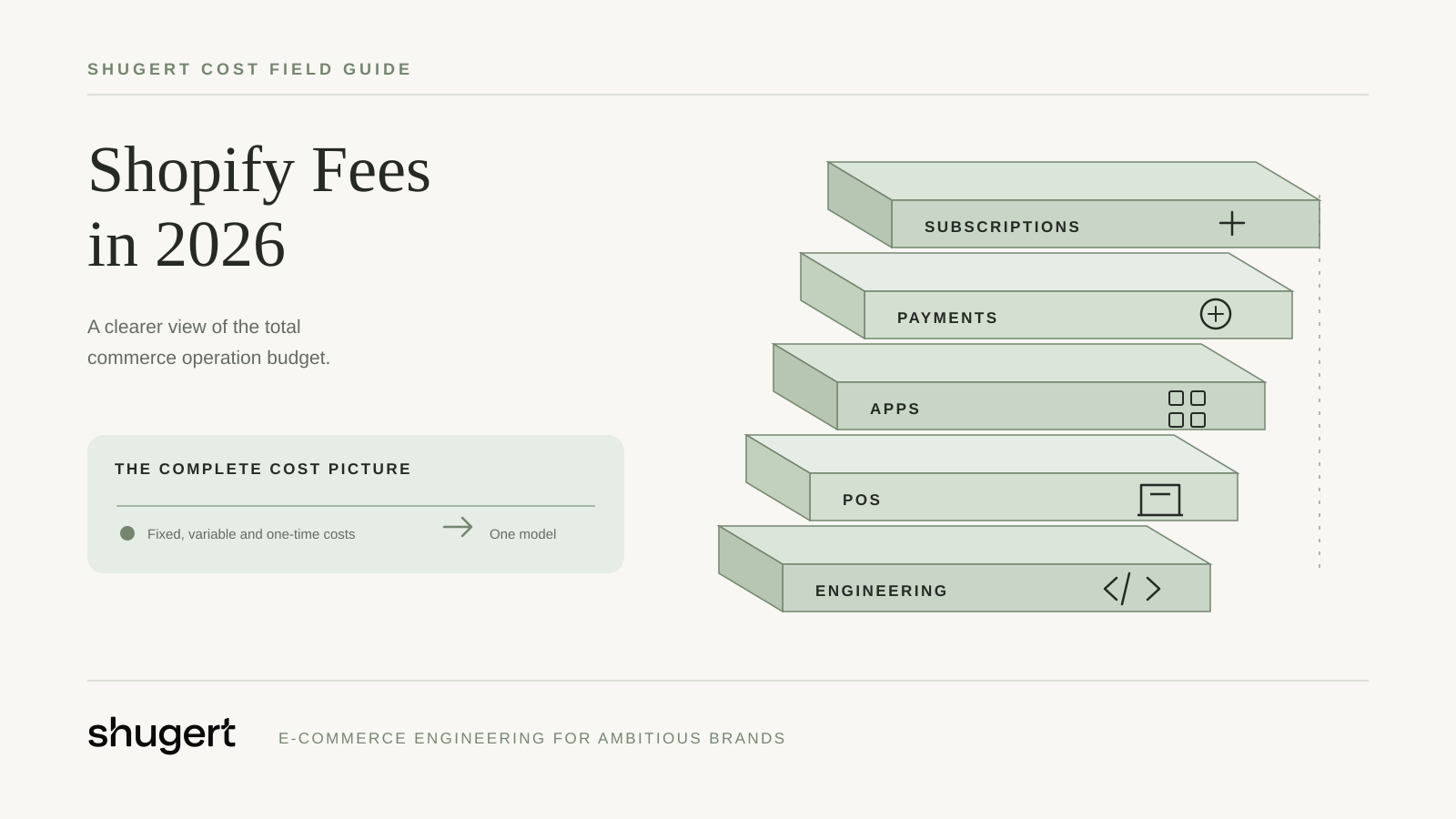
Shopify's subscription price is only the starting point of a merchant's budget. In the United States, Basic starts at $29 per month, Grow at $79 and Advanced at $299 when billed annually. Shopify Plus begins at $2,300 per month on a three-year term for standard arrangements. But the amount a business actually pays also depends on its payment mix, order volume, apps, tax calculations, POS locations, custom development and ongoing operations.
This guide separates those costs, works through payment-fee examples and shows how to compare plans using actual payment volume rather than a vague sales threshold. All US figures are based on publicly listed prices as of November 16, 2026; your checkout, contract and invoices remain the authority for your store.
Need this built properly? Our custom Shopify development team designs themes, apps and integrations as maintainable systems.
Shopify plan prices in the US in 2026
Shopify lists the following US subscriptions and starting online card-processing rates on its official pricing page. The processing numbers are not a guarantee for every card, country, merchant or payment method.
| Plan | Effective monthly price when billed annually | Price when billed monthly | Published online card rate, from | Extra Shopify fee on eligible third-party gateway transactions |
|---|---|---|---|---|
| Basic | $29 | $39 | 2.9% + $0.30 | 2% |
| Grow | $79 | $105 | 2.7% + $0.30 | 1% |
| Advanced | $299 | $399 | 2.5% + $0.30 | 0.6% |
| Plus | From $2,300 on a three-year term | From $2,500 on a one-year term | From 2.25% + $0.30 | 0.2% where applicable |
For Plus, contract length and complexity matter. Shopify's Plus plan documentation lists $2,500 per month for a one-year US term and $2,300 for a three-year term, for standard arrangements. Complex merchants can have variable platform pricing. A three-year Plus term is a different commitment from a standard month-to-month plan, so it should not be treated as a directly interchangeable monthly option.
On the standard plans, annual billing reduces the advertised subscription rate, but it creates a longer commitment. An Advanced merchant paying $399 month-to-month instead of the $299 equivalent annual rate pays $1,200 more over a full year. That does not necessarily mean annual billing is right if the merchant expects to change platforms, pause operations or restructure within the term.
What is not included in the subscription?
The plan price does not automatically include your app subscriptions, advertising, a paid theme, bespoke design or development, email or SMS tools, premium POS subscriptions or payment processing. The right cost comparison starts with the total monthly recurring expense plus the true one-time implementation budget. For more about an engineering project's separate scope, see our Shopify development cost guide.
Shopify payment processing fees: a $100-order example
Imagine a US store taking a standard eligible domestic online card payment for exactly $100, with no different cross-border or premium-card pricing. At the published starting rates, the Shopify Payments processing fee would be approximately:
| Plan | Illustrative fee on a $100 online card payment | Amount remaining before other business costs |
|---|---|---|
| Basic | $3.20 | $96.80 |
| Grow | $3.00 | $97.00 |
| Advanced | $2.80 | $97.20 |
| Plus | $2.55 | $97.45 |
The arithmetic is simple: payment amount × percentage rate + fixed per-transaction fee. Real invoices can differ with card type, location, currency conversion, negotiated terms, refunds and disputes. These examples do not include the cost of goods sold, shipping, marketing, tax services or apps, and they are not a profit calculation.
If Shopify Payments is your sole payment provider, Shopify says there is no separate third-party transaction charge for those Shopify Payments orders. It is important to distinguish this from the card processing fee, which still applies. With a different primary payment provider, your costs can be meaningfully different.
Third-party gateways can change the economics
If a merchant routes a payment through a supported outside gateway, that gateway generally charges its own processing fees and Shopify can impose its additional third-party transaction fee. Shopify's fee calculation guidance uses the order subtotal after discounts, plus taxes and shipping charges, as its base. Importantly, that base can exceed merchandise-only revenue, and the rules contain exceptions for payment methods, gift cards and store credit.
For an illustrative $1 million of eligible annual third-party gateway transaction value, Shopify's additional fee alone would be $20,000 on Basic, $10,000 on Grow, $6,000 on Advanced or $2,000 on Plus, before paying the gateway's own processor. This simplified comparison assumes every dollar is subject to the listed fee, which is rarely a perfect representation of a real merchant's mix.
Another configuration deserves attention. Shopify now documents cases where a store uses Shopify Payments alongside a direct third-party provider. Under the official mixed-provider rules, transactions handled by the outside provider incur plan-based third-party transaction fees, while eligible transactions routed through Shopify Payments can incur its usual processing rate plus a 1.25% premium. This is not a universal surcharge on every Shopify Payments order; the configuration and payment routing matter. Treat checkout and gateway selection as a specific modeling exercise before choosing a tier.
When does a higher Shopify plan pay for itself?
A higher plan does not become the right choice at $500,000, $1 million or any other universal annual-revenue threshold. It becomes economically attractive when verified fee savings and capabilities exceed its incremental subscription and implementation costs.
Consider Grow versus Advanced using only their published annual-billing rates and starting US online card percentages. The subscription difference is ($299 − $79) × 12 = $2,640 per year. The percentage difference is 2.7% − 2.5% = 0.20 percentage points. If the same eligible payment volume gets those rates on both plans, the simple break-even is:
$2,640 ÷ 0.002 = $1,320,000 in annual eligible processed volume.
At $1 million in that specific volume, the illustrative rate difference saves $2,000, which is $640 less than the extra subscription. At $2 million, it saves $4,000, or $1,360 more than the incremental subscription. The fixed $0.30 transaction component cancels only because the illustration assumes the same orders on both plans.
This is an illustration, not a Shopify eligibility threshold or a promise of savings. It ignores cards priced outside the starting rate, in-person sales, multiple payment gateways, contractual discounts and benefits from plan features. Pull twelve months of transaction exports and compare the exact fee categories before switching plans. If you need to choose specifically between Plus and Advanced based on B2B, checkout or API restrictions, read our separate Shopify Plus vs Advanced decision guide.
The costs beyond Shopify's plan fee
Apps and third-party subscriptions
Stores often accumulate apps for reviews, loyalty, subscriptions, search, returns, customer support, email and subscriptions. The monthly bill is only one cost: overlapping code, storefront scripts, support dependencies and broken integrations can raise maintenance costs or degrade customer experience. Review which apps actively contribute revenue or reduce labor, and retire duplicated functionality. Our research on third-party apps and storefront performance explains the technical side of this trade-off.
Themes and development
A paid theme is generally a separate purchase; a custom storefront, template work, B2B integration or theme remediation is an engineering engagement. Scope has a stronger impact than a generic 'Shopify website price': a store with straightforward products and a few templates is different from one integrating ERP inventory, subscription renewals, multiple markets or heavily customized product data. A maintainable theme can make future changes cheaper even when it requires more careful work upfront. See our theme architecture guide and Shopify development services.
Shopify POS and physical locations
In-person operations add hardware and potentially POS Pro licenses. For standard US plans, Shopify lists POS Pro at $89 per month for each POS Pro location in its POS pricing documentation. Five paid locations would therefore cost $445 per month for POS Pro alone, before any hardware or processing fees. Plus includes a different POS Pro allowance, so confirm the contract's location limits rather than multiplying the standard add-on rate across every plan.
Shopify Tax, international selling and currency conversion
Tax service fees and payment currency costs are easy to omit from a budget because they may not occur on every order. Shopify changed Shopify Tax threshold rules according to store creation date: stores created before May 13, 2026 can have annual free thresholds, while stores created on or after May 13, 2026 use a lifetime sales threshold before applicable tax-calculation charges. Published fees vary by store geography and plan, and there are order-level caps. Do not model them as a flat universal percentage of all revenue. International payment and currency fees likewise depend on the market and payment configuration.
Maintenance, measurement and opportunity cost
A Shopify invoice is not a complete operating-cost report. Engineering support, catalog maintenance, feed diagnostics, accessibility remediation, analytics and QA are ongoing responsibilities. A slow or fragile storefront may be expensive even when its direct subscription costs are low, because teams lose time to regressions and customers encounter friction. Those costs should be measured with conversion, Core Web Vitals and revenue-per-session baselines rather than guessed. When the main concern is organic traffic or technical performance, an audit through our Shopify SEO agency is usually more relevant than an automatic plan upgrade.
What a realistic first-year Shopify budget should include
Use a worksheet that separates costs by who charges them, how often they recur and which orders they apply to. This avoids double-counting a payment gateway charge as both Shopify revenue fees and processor fees.
| Cost category | How to model it | Data to retrieve |
|---|---|---|
| Platform subscription | 12 monthly equivalents plus contractual commitments | Shopify plan and billing settings |
| Shopify Payments | Actual eligible payment volume by rate type, plus fixed per-order fees | Payments and transaction exports |
| External gateways | Processor charges plus eligible Shopify third-party transaction fees | Gateway statements and Shopify invoices |
| Applications | Monthly subscriptions, usage tiers and per-order charges | Shopify app billing and vendor invoices |
| POS | Paid locations, hardware and card processing | POS configuration and bills |
| Shopify Tax/international | Eligible tax transactions, currency and cross-border charges | Store creation date, markets and billing |
| Development and migration | Fixed implementation scope plus post-launch support | Statement of work, acceptance tests, support plan |
For illustration, a store with a $79 Grow subscription, $150 in monthly apps, one $89 POS Pro location and $600 of allocated monthly engineering support would have $918 per month of these fixed/allocated costs. That is $11,016 annually before any payment processing, POS hardware, marketing, taxes or product costs. These are intentionally hypothetical inputs, not a benchmark for a typical Shopify store.
Building this line by line exposes the actionable decisions: consolidate unused apps, renegotiate payment rates where possible, simplify the theme, adjust POS licensing or adopt a plan with capabilities the operation demonstrably needs.
The migration cost is separate from the subscription
A migration from WooCommerce, Magento or BigCommerce to Shopify is not solved by choosing Basic, Grow, Advanced or Plus. It requires catalog and customer mapping, order-history decisions, 301 redirects, canonical and structured-data validation, analytics continuity, integrations and post-launch monitoring. If an important product or category URL loses its intended redirect, the technical issue can affect organic visibility regardless of whether the subscription is inexpensive. Our Shopify migration services cover this scoped engineering work separately from the platform's license.
By contrast, changing from Grow to Advanced on an existing Shopify storefront is generally a plan change, not a full replatform; its risks involve operational features and third-party dependencies rather than bulk URL migrations.
Ship complex Shopify builds without breaking the store
Fashionable Inc. has relied on us for more than six years across three Shopify Plus stores. Read the case study
Most quotes returned within 1 business day
FAQ: Shopify costs in 2026
How much does Shopify cost per month for a US small business?
The published Basic price is $29 per month on annual billing or $39 when paying month-to-month. Those amounts exclude payment processing and optional subscriptions, themes and services. The total depends on your payment volume and what you choose to add.
Does Shopify take a percentage of every sale?
Eligible card transactions carry processing charges, and some payment setups incur separate third-party transaction fees. Do not combine them into one universal percentage: the rates, exemptions and billing bases depend on the store and payment method.
Are Shopify's advertised card rates guaranteed?
No. Published rates are starting rates and can differ by card, region, payment method and merchant contract. Use your actual rates from billing exports for financial planning.
Is Shopify Plus cheaper for high-volume merchants?
Not automatically. Plus has a much higher platform fee, potentially lower payment rates and enterprise features. The correct calculation compares total incremental costs and the measurable operational value of those features. See when Plus is worth it versus Advanced.
Can I use Shopify Payments and another processor at the same time?
Certain mixed-provider configurations are supported, but they can trigger third-party transaction fees and a 1.25% premium on eligible Shopify Payments transactions. Verify the details of your setup before making price comparisons.
Bottom line: model the cost of the entire commerce operation
Shopify's starting plan price is useful for comparing subscription tiers, but it is a poor proxy for operating cost. The more useful question is which expenses scale with orders, which are fixed, and which produce a measurable return. Use a year of payment and app invoices, build a cost worksheet, and choose a plan on the basis of actual fees and needs rather than a revenue milestone.
If the exercise reveals duplicated apps, migration risks or theme problems, request a scoped Shopify engineering recommendation. Shugert can help evaluate the technical work separately from the platform bill so the decision is based on total cost and maintainability, not sales pressure.
US public pricing and product documentation checked November 16, 2026. Rates, offers, taxes and Plus contracts change; always validate your current Shopify agreement and merchant account.