Shopify Markets Hreflang Audit: Step-by-Step Checks
Run a Shopify Markets hreflang audit: crawl rendered URLs, check reciprocal tags, verify market availability and prioritize fixes after launch.
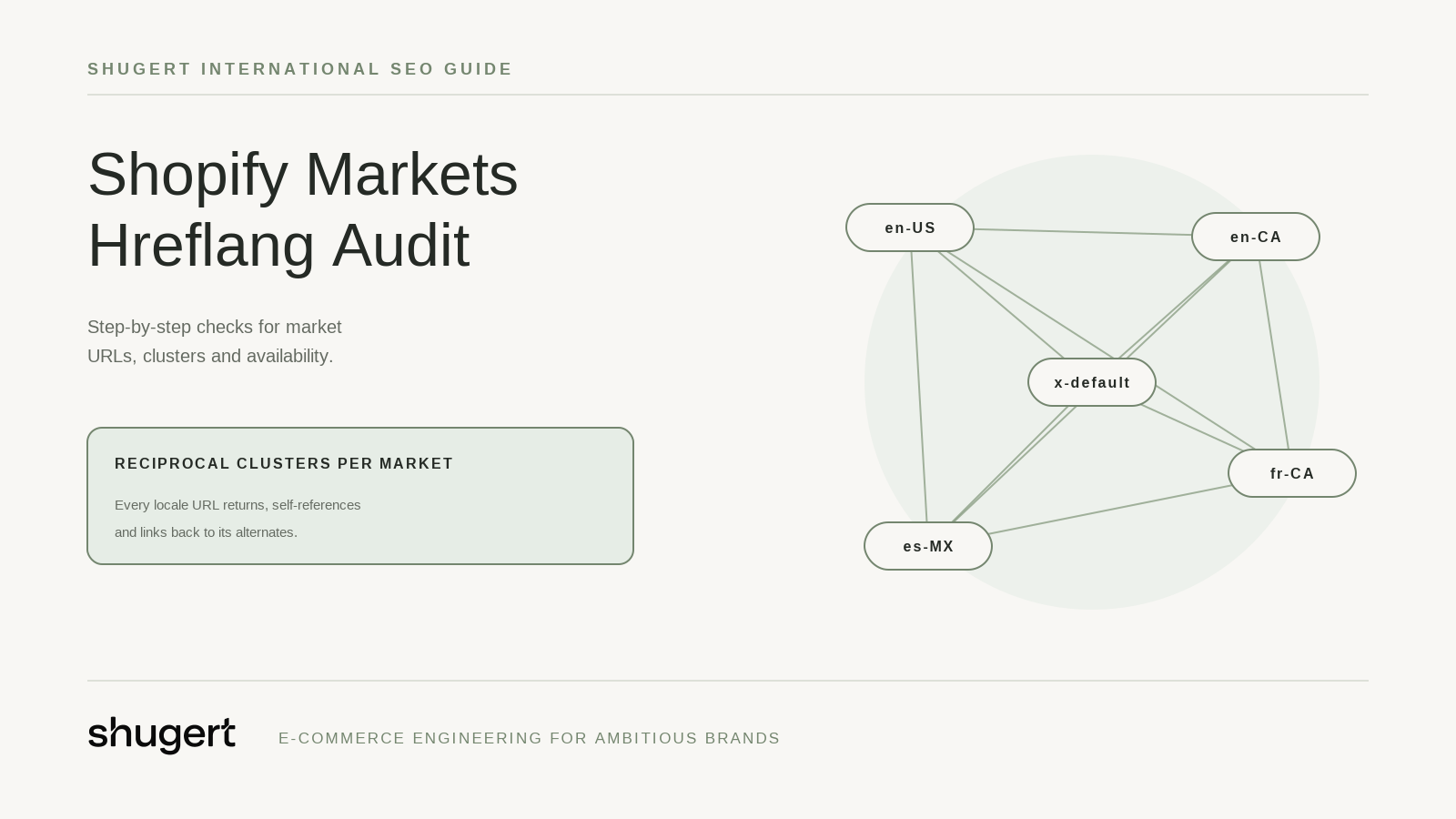
The international storefront is live, the language selector works, and the crawler reports hreflang tags on every sampled page. Yet Canadian shoppers still reach U.S. product pages, translated products redirect unexpectedly, and the merchandising team can't explain why a product appears in one market's alternate set but not another.
A Shopify Markets hreflang audit needs to establish more than tag presence. It must reconcile the configured markets, the URLs delivered to crawlers, and the products customers can buy. For an existing Markets store or a recent migration, the useful deliverable is an evidence-backed list of locale relationships to retain, repair, or remove, with an owner for each decision.
Want this implemented, not just audited? Our Shopify SEO agency ships technical, collection and content fixes and measures them against revenue.
Table of Contents
- Start With the Market and URL Inventory
- How to Crawl Rendered Locale URLs
- Pass Criteria for Each Hreflang Cluster
- Build an Availability Matrix by Product and Market
- Prioritize Fixes by Market Impact
- Measure Locale Cohorts After the Recrawl
- Decide Which Markets Keep Their Own URLs
Start With the Market and URL Inventory
Configuration comes before crawling. A crawler can discover the storefront's current links, but it can't determine whether those links represent the intended commercial structure. Starting with discovered URLs alone risks approving an implementation that consistently targets the wrong audience.
Shopify Admin should supply the initial inventory of active markets, assigned languages, public domains, and publication status. Record inherited or shared assignments explicitly. A market name isn't evidence that a distinct regional URL exists.
Shopify's Markets launch documentation establishes the connection between market configuration and international storefront architecture. Distinct domains, subdomains, and subfolders provide alternate destinations; markets sharing an undifferentiated URL don't create additional URLs merely because they represent different countries.
Currency strategy and store architecture should already be settled. The Markets multi-currency setup guide covers currency settings, while the Shopify multi-store guide addresses arrangements that widen the audit beyond one store.
Shopify Markets URL structures and what to audit
| URL structure | Example | Audit focus |
|---|---|---|
| Subfolder | yourstore.com/fr/ |
Shared host and sitemap entry point; confirm the folder resolves and matches the tag |
| Subdomain | fr.yourstore.com |
Host-level canonicals, sitemap entries, and crawler access per hostname |
| Country domain | yourstore.fr |
Separate property with its own indexing, sitemap, and redirects |
Build a matrix that someone can approve
Use a spreadsheet with a row for each market-language combination. The fields should capture both intent and implementation:
- Market and audience: Commercial region, language, and business owner.
- Assigned URL pattern: Canonical host, locale folder where applicable, and whether another market shares it.
- Expected annotation: Valid language or language-region value, plus the expected resource destination.
- Publication evidence: Published language, available templates, and the sitemap expected to contain each resource.
- Change history: Retired markets, previous domains, unresolved redirects, and the person approving the mapping.
Treat a shared English-language URL as an intentional architecture decision, not automatically as a missing alternate. Conversely, don't manufacture a regional path in the spreadsheet because the merchandising team expects one.
For a migration, legacy URL exports belong alongside this matrix. The Shopify migration planning guide provides the broader mapping context, including the relationship between catalog transfer and destination URLs.
The inventory is ready when each market-language row has a real URL pattern, an expected relationship, and a named approver. Unknown assignments remain open findings, not assumed passes.
How to Crawl Rendered Locale URLs
Use Screaming Frog SEO Spider in list mode for the controlled sample, then expand through internal links once the expected destinations are established. Browser DevTools and direct HTTP requests provide supporting evidence when a rendered page differs from its initial response.
Shopify's international-domain management documentation recommends checking hreflang configuration and published-language sitemap coverage. It also identifies retired market URLs as a redirect concern when those addresses return not-found responses.
The crawl should preserve the discovery path and the rendered result, rather than reducing everything to a tag count.
Collect comparable evidence
Choose representative resources. Include products sold across markets, products restricted to selected markets, collections, a content page, and cart or paginated URLs. Include the homepage as a control, not as the entire sample.
Request every assigned hostname unauthenticated. Remove account sessions and saved market preferences so personalized access doesn't contaminate the baseline.
Run HTML and JavaScript-rendered passes. Export status, canonical, and alternate annotations from both; differences identify behavior that needs investigation rather than an automatic diagnosis.
Inspect every annotation channel present. Compare rendered HTML with HTTP headers and sitemap annotations, while distinguishing ordinary sitemap inclusion from sitemap-based hreflang.
Repeat direct requests from another location. Record customer redirects and final destinations separately from crawler-access evidence; a browser location test doesn't establish what Googlebot receives.
Export by resource cluster. Keep requested URL, final URL, response status, canonical, robots directives, declared locale, alternate destinations, and annotation source in the same evidence sheet.
Capture the environment. Save the crawl date, a configuration snapshot, theme version, and relevant app changes so the next run compares like with like.
Before adding browser automation to investigate an app-dependent result, Clearcote Labs' guidance to check HTML and JSON first offers a useful inspection sequence. Initial responses can reveal whether a discrepancy originates before JavaScript execution.
Keep storefront behavior in the record
Shopify's international SEO documentation connects generated SEO signals to market, domain, and language configuration. That makes the rendered storefront the evidence to compare with the inventory, not a substitute for that inventory.
A populated tag set can still describe the wrong language, market, or product destination.
Common slips include crawling only the homepage, testing through a logged-in session, and inspecting cached output immediately after a deployment. Cart and other intentionally non-indexable templates remain diagnostic samples, not automatically eligible cluster members. A cluster is fully evidenced only after the collection steps and any unverified fields are recorded.
Pass Criteria for Each Hreflang Cluster
Per-URL pass conditions for hreflang clusters
| Check | Pass condition | Typical failure |
|---|---|---|
| Final status | HTTP 200 directly, with no redirect | Alternate points to a 301 chain or a 404 URL |
| Self-canonical | Canonical equals the tested indexable locale URL | Canonical points to a parameter variant or another market |
| Language-region code | Valid code such as en-US or fr-CA |
Mislabeled code such as UK for GB |
| Self-reference | Each page lists itself in its own set | Hreflang set omits the page itself |
| Reciprocal link | Every declared alternate links back | One-way tag from a translated template |
| Indexability | Page is indexable and included in the expected sitemap | Noindex page or unexplained sitemap omission |
| x-default | Optional; if present, identifies the intended fallback | Treated as another country code or sent to an inappropriate fallback |
These are operational acceptance conditions, not a claim that every item is a mandatory Google annotation requirement. In particular, sitemap inclusion supports discovery and audit consistency; it isn't a prerequisite for valid HTML hreflang.
Google Search Central's localized-version guidance requires fully qualified alternate URLs, self-references, and return relationships for the versions being declared. It supports HTML, HTTP-header, and sitemap implementations without requiring all of them simultaneously.
Separate structural failures from policy choices
Canonical conflicts deserve close attention. A French product that declares itself as an alternate but canonicalizes to the U.S. product sends inconsistent instructions about which URL should be indexed. The engineer should establish whether that consolidation was intentional before changing either signal.
Reciprocity must be tested from the destination, not inferred from the source. A U.S. page pointing to its French equivalent proves only that outgoing relationship. The French page's response supplies the evidence for the return relationship.
x-default is optional. Its absence doesn't fail an otherwise valid cluster. It can identify a neutral selector or a suitable existing fallback, including a primary-market resource that serves unmatched visitors; the fallback doesn't have to be a separate neutral URL.
Report exact failures
A strict internal acceptance test can require every eligible cluster member to satisfy the applicable checks. However, the findings should preserve pair-level detail, since an incomplete relationship doesn't necessarily invalidate every valid reciprocal pair.
- Hard failures: Missing destinations, blocked access, conflicting locale destinations, and non-indexable pages presented as search targets.
- Normalization issues: Redundant parameters, inconsistent URL formatting, or duplicate identical annotations.
- Policy questions: Intentional consolidation, fallback selection, and whether a market deserves a distinct indexed page.
A parameterized destination that redirects or canonicalizes elsewhere isn't merely cosmetic. Its actual response determines severity.
Broader canonical or indexation conflicts belong in a technical SEO cleanup scope, rather than an isolated tag replacement. Passing these checks establishes coherent targeting signals, not a ranking guarantee.
Build an Availability Matrix by Product and Market
Create a grid with products as rows and markets as columns. Each cell should describe publication, commercial eligibility, and the final localized resource, rather than just whether a URL returns successfully.
Keep publication and inventory in separate fields. A product can be published but temporarily unavailable, or technically reachable while excluded from sale because the merchant can't ship it to that market.
Availability cell states by product and market
| Cell state | Include in alternate cluster | Action |
|---|---|---|
| Sold and published | Yes | Verify price, currency, inventory, tax, and shipping, then record the final landing URL |
| Published but excluded for legal, shipping, or tax reasons | No | Keep out of the intended purchasable cluster and document the exclusion |
| Published but temporarily out of stock | Yes | Keep in the cluster and log stock separately from publication |
| Not published in the market | No | Don't substitute a collection or the homepage |
| Equivalent page exists but is unexpectedly missing from a market | No until resolved | Investigate catalog or market configuration and fix the source |
The exclusion state needs interpretation. A page intentionally retained as useful, indexable product information may require a different SEO policy from a page mistakenly exposed to shoppers who can't purchase it. The matrix should document that exception rather than treating every reachable page as commercially eligible.
Test the product, not just the path
Hypothetical example: A replacement component is published for U.S. and Canadian customers but isn't offered in France. Its Canadian version is temporarily out of stock, while a French collection contains related products.
The expected product cluster includes the equivalent U.S. and Canadian pages. The French collection isn't a substitute for the missing product, and Canadian stock status alone doesn't justify removing the Canadian destination.
Shopify's product-level generation follows market inclusion, so an intentionally absent product can legitimately have a smaller alternate set. An unexpected gap belongs with catalog publication or market assignment before anyone adds custom tags.
For each eligible cell, the tester should select the market explicitly, open the product directly, and record currency, price, stock, shipping eligibility, and final URL. Browser language and a country selector provide more useful customer evidence than relying entirely on automatic IP routing.
Preserve product identity through migration
Legacy URLs should resolve to the corresponding Shopify product, not merely an available page. Sample redirect chains from the source platform and compare their final destinations with the localized product map.
The Magento-to-Shopify migration guide and BigCommerce migration guide provide platform-specific mapping context. Commercial access and regional offer inconsistencies belong with geo-commerce optimization when the defect extends beyond SEO annotations.
Availability rule: Empty cells need an explanation, not a replacement homepage.
Prioritize Fixes by Market Impact
Fix priority by finding
| Finding | Priority | Layer to fix |
|---|---|---|
| Wrong-locale landings on high-value product pages | High | Market domain or language settings |
| Alternate points to a redirected or noncanonical URL | High | Market URL setup or theme alternate output |
| Missing reciprocal tag on one translated template | Medium | Theme template or translation app |
| Language-only code where region changes the offer | Medium | Market language and region settings |
| Missing x-default on a site that needs a fallback | Low | Market fallback configuration |
Priority should reflect affected customers and resources, not the crawler's warning count. A single configuration error across a commercially important market can deserve attention before numerous redundant annotations on low-demand pages.
The table provides starting owners, not diagnoses. Wrong-locale landings can also involve redirects, internal links, or Google's canonical selection. A language-only code is valid when the page targets that language broadly, so regional labeling should follow the intended audience rather than a desire to clear a warning.
Trace the generator before changing output
Native theme output, custom Liquid, and translation apps can each contribute annotations. Inspect the complete head and identify which system produced the conflicting destination before editing code.
For an Online Store theme, the inspection should include content_for_header in the head and any custom alternate-generation logic around it. Removing that object isn't an appropriate way to remove unwanted hreflang because its role extends beyond those tags.
Hypothetical defect: A translated French product declares an alternate that redirects to a URL whose canonical points elsewhere. The team should resolve the mapping at its source:
- Establish the intended resource. Match the product identity to its final localized destination and confirm the corresponding market assignment.
- Correct the responsible layer. Change the market URL setting if it's wrong; adjust theme or app output only if that generator supplies the stale mapping.
- Verify the affected relationships. Request both destinations directly and inspect the outgoing and return annotations.
- Recrawl the changed cluster. Confirm fresh responses after cache propagation, then run the relevant regression sample.
Changing both Markets and theme code without identifying ownership can introduce a second defect. Hardcoded domains also create maintenance work whenever domains, translated handles, or market assignments change.
Keep the change record narrow
Each finding needs an owner, affected resource cluster, before-and-after evidence, deployment date, and rollback reference. Mark untouched passing relationships explicitly so another engineer doesn't rebuild them unnecessarily.
Repair the faulty relationship without replacing a working international URL system.
Acceptance should follow observed fresh output, not an assumed cache duration. The repair record can establish technical correctness; it can't promise a ranking increase.
Measure Locale Cohorts After the Recrawl
Group URLs by country, language, and canonical resource before comparing performance. Country alone mixes different languages and products, while sitewide traffic can hide a regional routing problem.
For each cohort, establish whether Google indexes the intended URL, which locale receives organic landings, and whether eligible shoppers can complete the purchase. Keep Search Console observations separate from analytics sessions because they describe different parts of the journey.
Define an acceptance metric the team can reproduce
Use correct-country landing rate as the primary targeting measure: eligible organic landings on the intended regional URL divided by the cohort's eligible organic landings. Language-level or intentionally shared destinations need their own documented acceptance rule, rather than being counted as wrong-country visits.
Supporting measurements should include:
- Search visibility: Impressions, clicks, and landing URLs from Search Console, filtered by country and resource cohort.
- Indexing evidence: Indexed status and Google-selected canonical for representative affected URLs.
- Commercial behavior: Organic sessions, conversion rate, and orders by market where analytics supports that segmentation.
- Change context: Deployment date, engineering recrawl date, observed search-engine recrawls, and concurrent merchandising changes.
The risk isn't theoretical: Ahrefs' hreflang study found noncanonical hreflang targets on 8% of audited domains. That finding supports checking conflicting destinations, but it doesn't predict the outcome of a particular Shopify repair.
Compare equivalent periods without claiming causation
Compare periods with similar trading conditions. Promotions, changed product availability, pricing, content releases, and seasonality can all affect the same cohort, so those changes belong in the measurement log.
The engineering recrawl verifies deployment, not Google's adoption. Search reporting and indexing can take longer to reflect the corrected relationship, so evaluation should span weeks rather than the first post-deployment check.
No verified before-and-after result supports a traffic-lift claim here. Hreflang helps search engines select appropriate localized URLs; it doesn't guarantee more traffic or immediate indexing.
For SEO continuity, Shugert Marketing inventories valuable URLs, builds a redirect map, validates canonicals and sitemaps, and monitors Google Search Console after launch. The SEO engagement isn't a fit when the merchant can't grant access to Search Console, analytics, or the theme, since measurement and implementation require those permissions.
Decide Which Markets Keep Their Own URLs
A regional URL should stay indexable when it serves a distinct, useful shopping experience. A valid hreflang cluster alone does not justify separate URLs if markets share a language, catalog, pricing logic, and fulfillment terms.
Shopify's market domain and language guidance describes subfolders, subdomains, and separate domains. Choose among them based on the market experience you need to maintain, not on the number of markets configured.
Assign a decision and an operating owner
| Market condition | Decision | Maintenance work to record |
|---|---|---|
| Shared language, catalog, pricing logic, and fulfillment | Consolidate where appropriate | Redirects, internal links, analytics grouping, and shared-language ownership |
| Meaningful translated demand and localized copy | Localize | Translation review, resource mapping, and publishing QA |
| Thin placeholder or a documented indexing restriction | Noindex where justified | Indexing policy, removal from intended search clusters, and review date |
| Different regulations, assortment, or commercial terms | Retain as a distinct indexable experience | Regional content, catalog QA, canonicals, sitemaps, and reporting |
Consolidation needs a destination policy, resource-level 301 redirects, updated navigation, and analytics that recognizes the shared experience. Removing a market folder without mapping its URLs can leave shoppers and crawlers at the wrong destination.
Noindex is not a substitute for deciding what a market page should do. A legal requirement to display content does not, by itself, establish that indexing should be blocked. Have the responsible legal and SEO owners document the constraint.
Close the audit with implementation decisions
Record an owner and a qualitative maintenance estimate for each market. Translation, catalog review, analytics segmentation, redirects, and regression testing all require ongoing capacity, even when Shopify generates hreflang tags automatically.
Staging can test corrected templates, but preview hosts and access restrictions limit what it proves. Final acceptance should check production hosts, rendered destinations, and the paths shoppers use to reach products.
For replatforming, include these decisions in the full Shopify migration launch plan. The Shopify SEO team handles post-launch work for established stores with organic demand, a meaningful catalog, and the ability to implement structural changes.
Shugert Marketing confirms Shopify SEO pricing in writing after reviewing Search Console, the catalog, and the templates. The scope should distinguish configuration repairs, template changes, and market consolidation so each hreflang issue has a defined fix.
Migration and custom development projects start at $5,000, with timelines of 4 to 24 weeks. To request an international SEO audit scope, provide the market list, a Markets configuration export, and Search Console access so the assessment can cover cluster corrections, unresolved availability decisions, and production acceptance checks.
Grow organic revenue, not just rankings
Fashionable Canes recovered its rankings within 60 days of a 15,000+ SKU Shopify Plus theme migration. Read the case study
Most quotes returned within 1 business day