How to Choose a Shopify SEO Agency: 10 Questions That Matter
Learn how to choose a Shopify SEO agency with 10 technical questions, a six-part scorecard, warning signs, and a practical selection process.
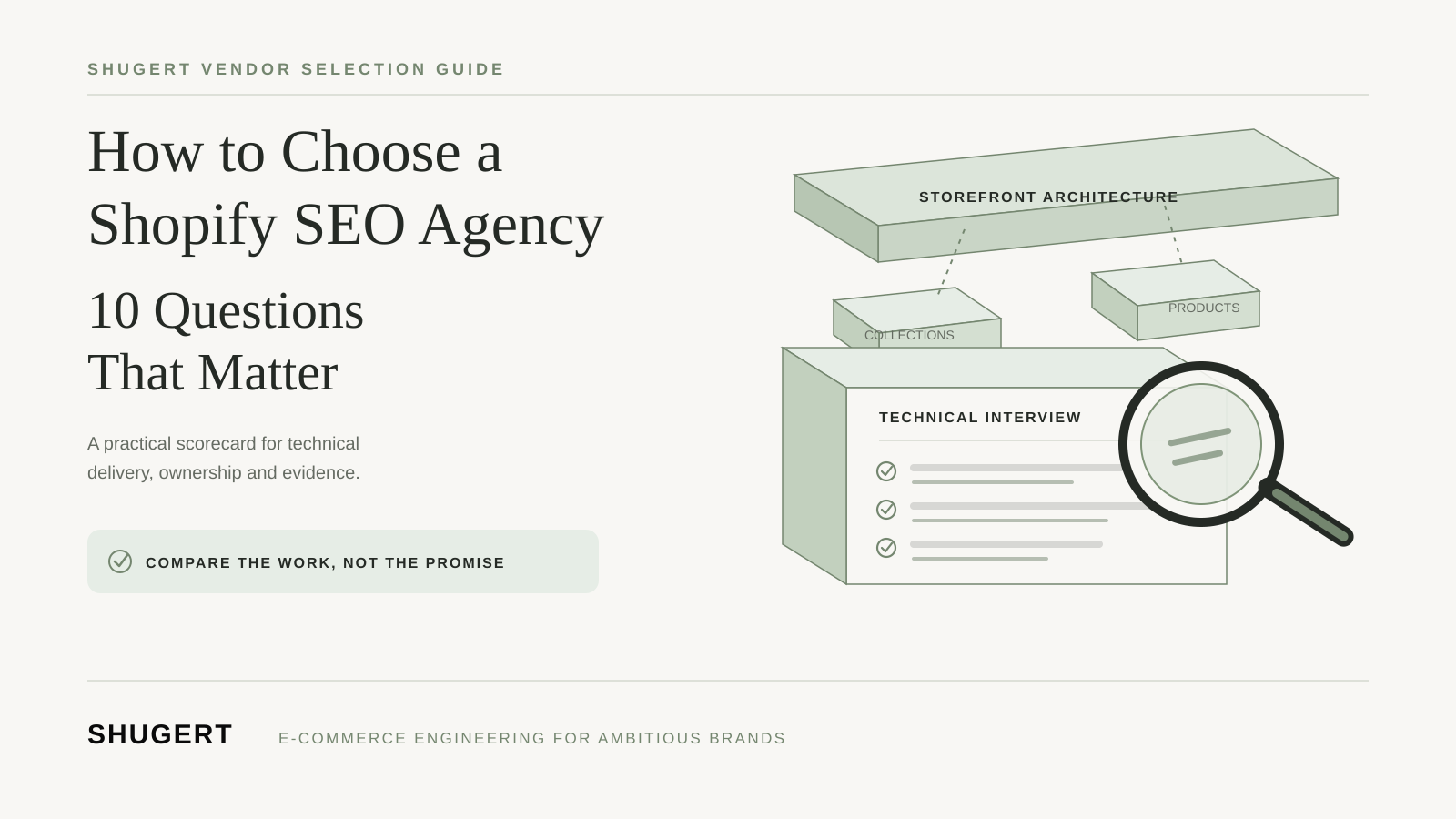
Choosing a Shopify SEO agency is harder than comparing rankings or monthly retainers. One proposal promises more content, another lists hundreds of audit findings, and a third offers guaranteed visibility. None of those tells you who will implement the work, whether that team understands Shopify, or how you will evaluate its impact on your business.
For an established ecommerce store, the best agency is not necessarily the largest or most expensive. It is the partner that can diagnose your specific constraints, make changes safely and measure what happened afterward. This guide gives you a practical way to compare candidates: six criteria, ten questions for a technical interview and a realistic framework for the first 90 days.
Want this implemented, not just audited? Our Shopify SEO agency ships technical, collection and content fixes and measures them against revenue.
What a Shopify SEO agency should actually deliver
Shopify already includes much of the SEO baseline. It generates canonical tags and sitemap and robots files, and merchants can edit page titles, meta descriptions and URL handles. These are documented in Shopify's SEO overview. Their existence does not eliminate SEO work, but it changes what you should expect to pay an agency to do.
A capable partner should establish how search engines encounter your actual catalog, where search demand maps to products and collections, what prevents pages from being crawled or indexed, and which fixes affect qualified traffic or revenue. That often requires access to the Shopify theme and data, not simply a content calendar. For an illustration of the technical scope, see our Shopify SEO audit guide.
The core deliverables should be specific: an evidence-backed prioritization, owners for implementation, accepted changes with QA records, an internal-linking plan and measurement after release. A proposal focused on activity counts, such as a fixed number of posts or unspecified 'on-page optimizations,' is not a substitute for that scope.
The Shopify-specific problems a generalist may miss
Shopify's default features are useful, but store architecture can create challenges that a generic audit does not resolve. Products can appear in product URLs and collection-context paths; filters can create crawlable combinations; app scripts can affect storefront performance; and variant presentation can require decisions about canonicalization, product markup and landing-page strategy. These require judgment rather than a universal 'noindex everything' rule.
Google's ecommerce URL guidance explains how multiple URL versions and query parameters can waste crawling or introduce duplicate representations. The correct remedy depends on whether a filtered or variant page serves a distinct search intent, how internal links are generated and how Shopify outputs canonical tags. Google also emphasizes crawlable navigation links: an XML sitemap is helpful, but it should not replace meaningful connections from collections to products.
The agency should be comfortable examining Liquid templates, schema, pagination, redirects and app-generated markup, then shipping targeted fixes. Ask whether the team uses a Shopify staging and release workflow to compare the proposed change with the current storefront before it goes live.
When an agency is worth hiring, and when it is not
An agency can make sense when your store needs coordinated decisions across SEO, development and merchandising. Examples include large or frequently changing catalogs, recurring indexation problems, an organic traffic plateau, complex B2B product visibility or a planned platform migration. The common requirement is not a particular revenue threshold: it is the need for specialized implementation and accountable ownership.
For a narrow task, a capable freelancer or a fixed-scope engagement may be more efficient than an ongoing retainer. A merchant who only needs a handful of redirects or an isolated collection-template correction should not be pushed into a broad SEO subscription. Conversely, if you are planning a replatform, redirects, product-data parity, analytics and search visibility belong in the launch plan from the beginning. Our Shopify migration service addresses that broader risk when it applies.
Six criteria for evaluating a Shopify SEO partner
Use the same scorecard for every candidate and assign 1 to 5 points for each category. Ask for evidence before awarding a four or five. The total, out of 30, is a comparison aid, not a prediction of results.
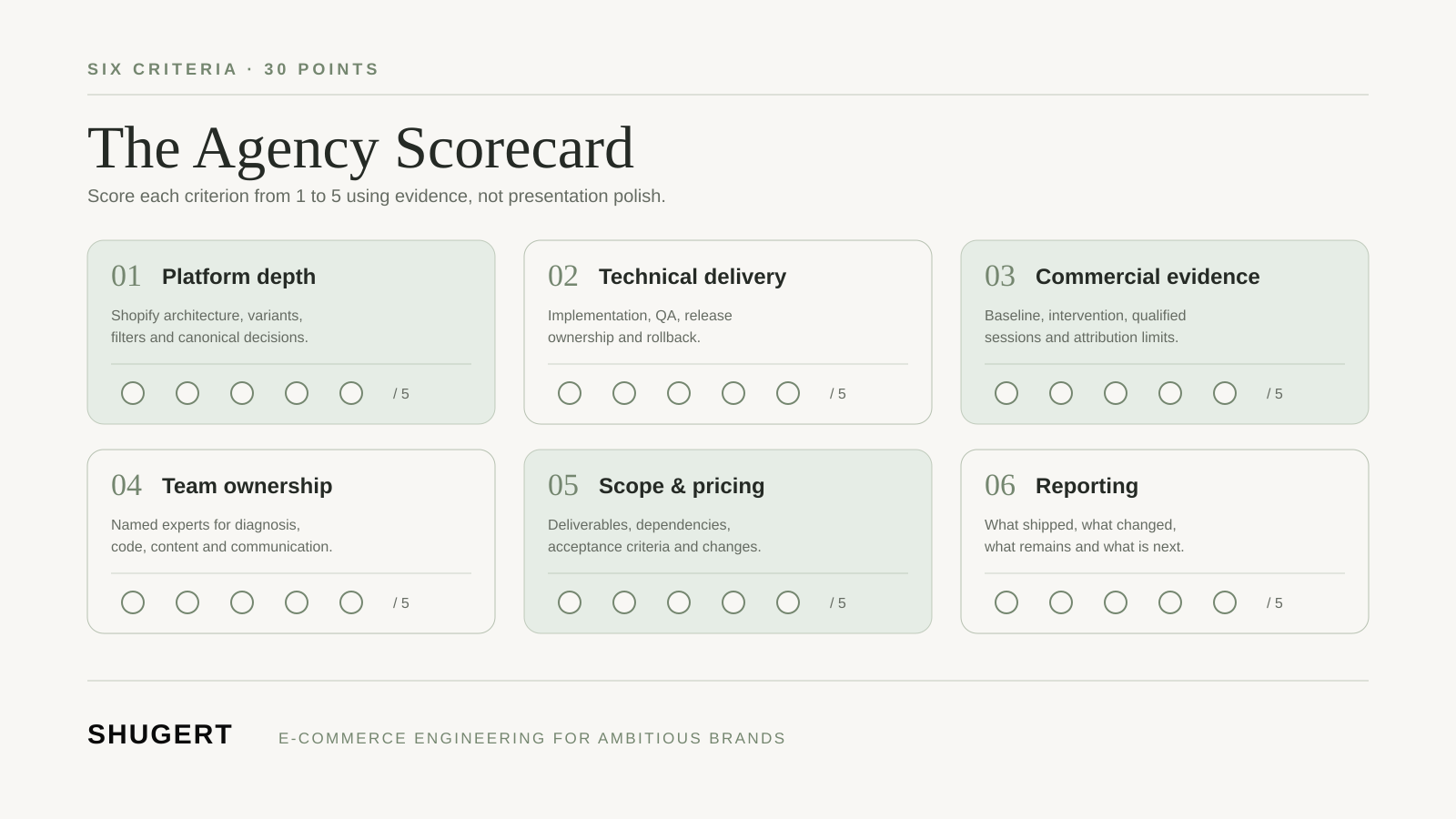
1. Platform depth
Ask about duplicate collection-product paths, canonical and variant decisions, filtered collections and collection architecture. Strong answers identify the conditions under which each approach makes sense. Weak answers present the same checklist for Shopify, WordPress and every other platform.
2. Technical implementation
Find out whether the people performing the audit can implement and QA the changes. If recommendations are handed to another developer with no shared ownership, the work may stall or change in translation. The agency should explain how it tests new Liquid code, handles app conflicts and rolls back a bad release.
Performance belongs in this discussion. Google's recommended 'good' Core Web Vitals thresholds are LCP at or below 2.5 seconds, INP at or below 200 milliseconds and CLS at or below 0.1, measured with real users. Google's Core Web Vitals documentation explains what these metrics measure. Do not accept a claim that installing one speed app guarantees passing results.
3. Evidence connected to business outcomes
Rankings and impressions are useful diagnostics, but merchants need to understand changes in qualified sessions, conversion and attributable organic revenue where reliable data exists. Ask to see an example showing the baseline, the intervention, the observation period and the limitations of attribution. Beware unverified cause-and-effect claims from a screenshot that merely shows a rising traffic line.
4. The team doing the work
Confirm who diagnoses problems, writes code, approves content, tests releases and communicates with you. Ask whether the senior expert who discusses the work in the sales call will still be responsible when implementation begins. The answer can matter more than an agency's headcount.
5. Commercial model and scope
A retainer can be appropriate for an ongoing backlog; a fixed-price project can suit a discrete technical cleanup; hourly billing may be sensible for a bounded task. None is automatically superior. Favor proposals that define deliverables, dependencies, assumptions, acceptance criteria and how a change in scope is handled. For a related breakdown of engineering scope, see our Shopify development cost guide.
6. Reporting and governance
A good report identifies what shipped, which issues remain, changes in search visibility and conversions, and the next priorities. It should explain data quality issues, especially attribution and tracking gaps, rather than hide behind a single dashboard score. The merchant should be able to link results to actual changes made.
Ten questions to ask before signing an SEO agreement
Use these during a technical call, ideally with someone from your development or ecommerce operations team present.
- What would you investigate first on our store, and why? Look for hypotheses tied to your site and business, not a copied audit checklist.
- How do you handle collection-product URLs, filters and variant indexing? Ask for a decision process, not an automatic rule.
- Who will implement the technical fixes? Establish whether the agency owns both recommendations and deployment.
- What will you do before, during and after a major theme change or migration? Expect redirects, baseline recording, QA and post-release monitoring.
- What exactly is included in the scope and acceptance criteria? Make vague terms like 'optimize collections' testable.
- How will you connect SEO changes to qualified sessions and revenue? Ask about tracking and attribution limitations.
- Have you worked on catalogs with constraints similar to ours? Complexity, integrations and SKU structure are often more useful comparators than revenue alone.
- How do you decide which URLs to index, consolidate or keep out of search? They should discuss evidence and the cost of mistakes.
- What access and cooperation will you need from us? Clarify theme access, analytics, merchandising decisions, approval and developer time.
- What happens if a release causes ranking, performance or conversion regressions? Look for monitoring, escalation and rollback ownership.
Question ten is particularly revealing. A team that has deployed changes to live commerce systems will normally be able to describe release gates and incident response. It is reasonable for an agency to need deeper access before providing a final recommendation, but it should still explain its method.
Warning signs in SEO proposals
Be cautious with guaranteed rankings, paid-link packages without editorial standards, generic audits, vague monthly deliverables and claims that apps will fix every technical issue. Pay special attention to agencies that cannot identify who will ship code or how results will be evaluated. You do not need to dismiss every low-cost provider, but you do need to know whether you are buying strategy, implementation, content production or all three.
Stores with restricted B2B catalogs need added care. The agency should understand the difference between public landing pages that search engines should index and pricing or account-restricted content that should remain protected. A casual recommendation to expose private collection URLs or block all B2B pages can be commercially damaging.
How SEO agency pricing models compare
| Engagement | Typically useful for | Key question to ask |
|---|---|---|
| Monthly retainer | Continuous technical, content and architecture backlog | What ships each month and how is priority reviewed? |
| Fixed-scope project | Audit, technical remediation, migration protection | What are the acceptance criteria and exclusions? |
| Hourly implementation | Small, bounded fixes or specialized advisory | How are estimates, caps and progress communicated? |
The pricing label is less important than accountability. Ask for a written statement of work, required approvals, documentation, test expectations and a process for evaluating outcomes. If a provider only promises 'ongoing optimization' with no explicit outputs, you cannot compare its offer meaningfully.
What the first 90 days could look like
The following is an illustrative sequence, not a guarantee that every store can complete a project in three months. A migration, large catalog or high-risk integration may require more discovery and a longer release plan.
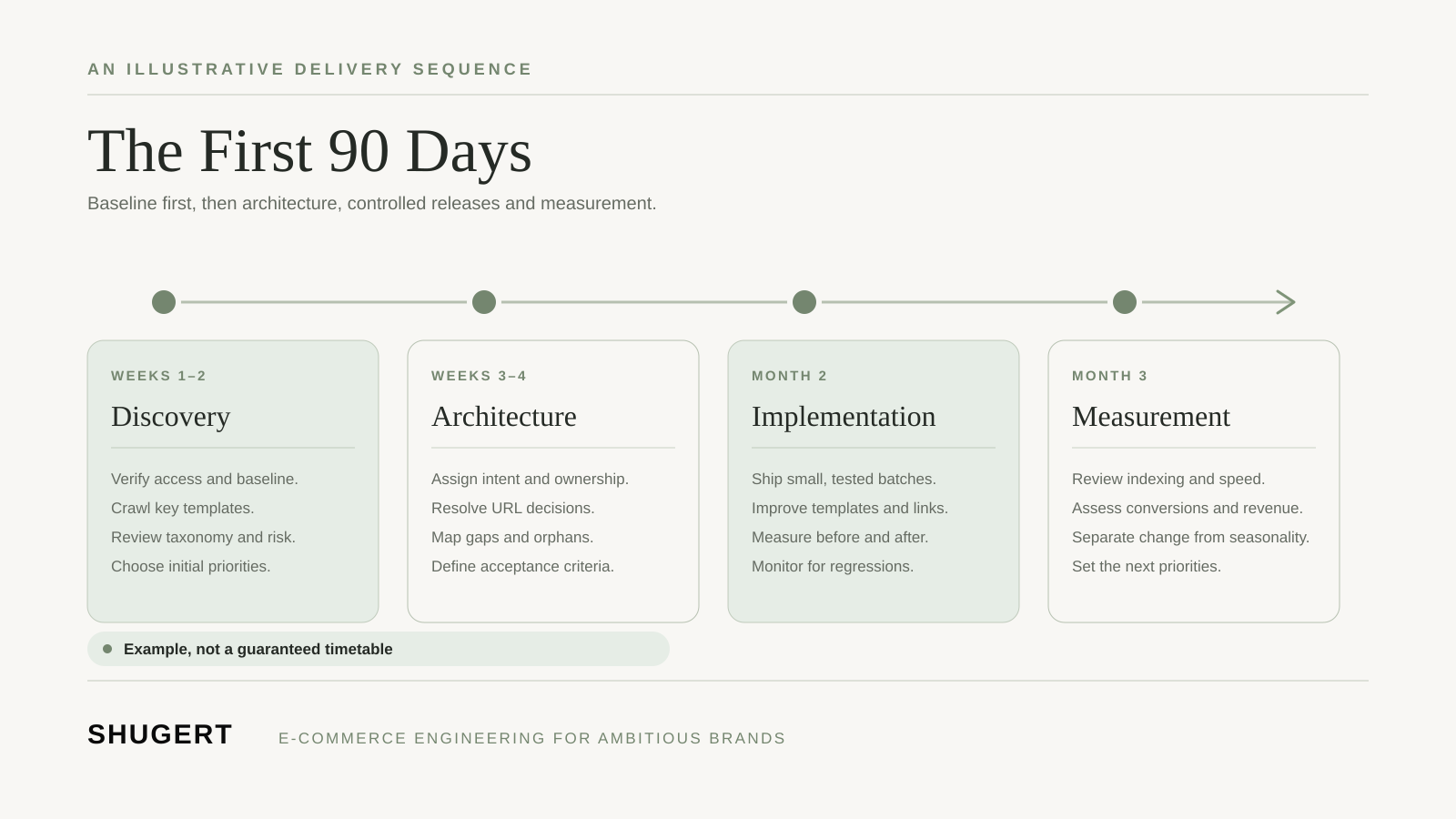
Weeks 1–2: baseline and discovery. Verify Search Console and analytics access, crawl representative templates, inspect canonical/indexation behavior, review the collection taxonomy and choose a short list of priorities by risk and potential impact.
Weeks 3–4: decisions and implementation plan. Agree on search intent and page ownership, resolve architecture choices, map duplicate or orphaned URLs and define technical acceptance criteria. Some low-risk fixes may ship here after testing.
Month 2: controlled releases. Implement prioritized theme, internal-link and collection changes in small batches. Measure key metrics before and after, and monitor error logs, templates and organic landing pages for regressions.
Month 3: measurement and iteration. Review crawling, indexing, Core Web Vitals, conversions and organic revenue. Separate what can be attributed to a shipped change from seasonal or market variation; set the next engineering and content priorities accordingly.
For many stores, collection pages are an early commercial opportunity because they match broad shopping intent. Our collection page SEO guide explains their role in the architecture. When analytics loses events or client-side scripts produce unreliable data, server-side tracking may also be relevant to measurement, but it is not an SEO shortcut.
Where Shugert fits
Shugert has worked as a Shopify Partner since 2015, combining engineering and technical SEO for merchants that need work implemented rather than simply recommended. The right engagement may be a focused technical cleanup, a collection architecture project, ongoing support or migration protection. We scope the technical constraints first instead of recommending a retainer solely from revenue size.
For teams evaluating deeper technical support, our Shopify SEO agency services explain the areas we cover. The objective is to connect audits, theme changes, measurement and release quality in one accountable process. If the need is limited, we can identify a smaller fixed-scope project rather than positioning a full SEO program as the only option.
A practical selection process
Start with a one-page brief that includes catalog size, organic-search baseline, major technical problems, planned releases or migrations, and what your team can implement internally. Ask a short list of agencies to respond to the same brief, name their delivery owners and show a scoped plan. Conduct the technical interview using the ten questions above, score each agency against the six criteria, and check references when available.
Choose the team with the clearest diagnosis, realistic dependencies and strongest evidence of safe execution, not the most elaborate proposal. A useful vendor selection process reduces the risk of signing a retainer before either side understands the actual work.
Grow organic revenue, not just rankings
Fashionable Canes recovered its rankings within 60 days of a 15,000+ SKU Shopify Plus theme migration. Read the case study
Most quotes returned within 1 business day
Frequently asked questions
Can I handle Shopify SEO without an agency?
Yes. Smaller stores can improve titles, descriptions, collections, internal links and content directly in Shopify. More complex architecture, indexing and performance work may require a developer or specialized advisor.
Should I hire a Shopify SEO freelancer or an agency?
A freelancer can be effective for a narrow, well-defined task. An agency may be a better choice when SEO strategy, coding, content and measurement must be coordinated, provided it clearly owns delivery.
Does Shopify automatically handle SEO?
It handles foundational items such as generated sitemaps, robots files and canonical tags, but it does not automatically solve keyword targeting, collection architecture, internal linking, content quality or every technical issue.
What should a Shopify SEO proposal include?
Specific deliverables, owners, scope exclusions, assumptions, acceptance criteria, timeline or cadence, reporting, and a plan to test and monitor technical changes.
Is SEO still relevant for Shopify stores in 2026?
Yes. Organic product and collection discovery still matter, while AI-assisted search adds more reasons to maintain clean site architecture, accurate structured content and measurable performance. No vendor can guarantee rankings or citations.
Final takeaway
The right Shopify SEO partner understands Shopify's technical constraints, implements its recommendations and is accountable for testing and measurement. Compare agencies by evidence, team ownership and scope, not promised rankings or content volume. Use the ten questions and scorecard above before making a commitment.
If you want a technical team to evaluate your store, explore Shugert's Shopify SEO services or request a scoped recommendation. A focused project can be a better first step than an open-ended retainer.
Documentation reviewed November 16, 2026. Platform behavior and Google guidance may change; confirm current requirements before implementation.