Shopify Migration Cost: What Drives Your Budget in 2026
Shopify migration cost starts at $5,000 for a straightforward catalog and rises with integrations, custom features and data volume. See the real drivers.
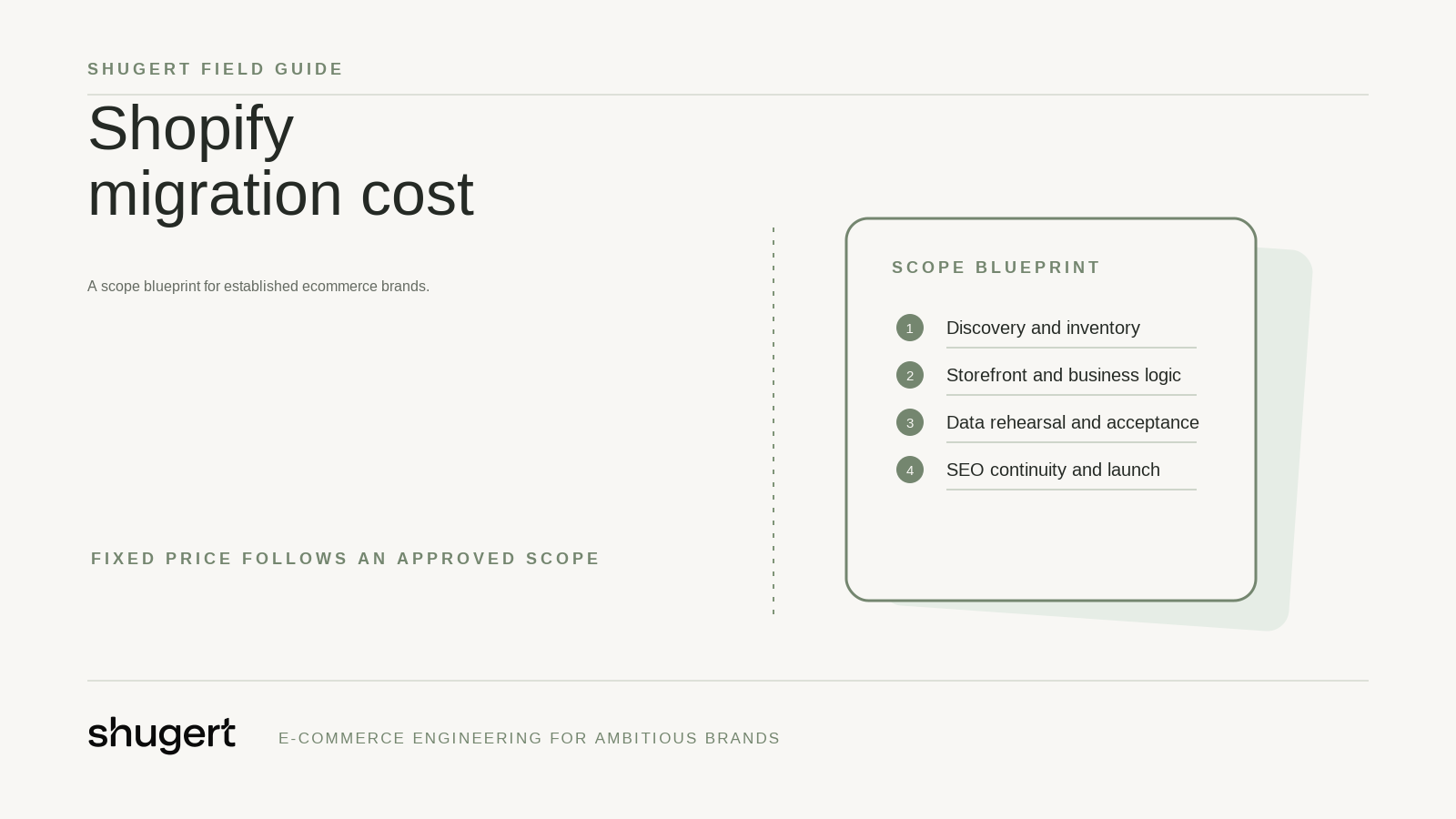
Shopify migration projects start at $5,000 for an approved, fixed-price scope, with typical timelines of 4 to 24 weeks. The counterintuitive part is that catalog size alone doesn't determine the bill: replacing hidden business logic and funding the post-launch operating model can matter more than building the storefront.
The benchmark table below separates a focused agency engagement from broader replatforming programs. For established DTC and B2B brands leaving WooCommerce, Magento, BigCommerce or a headless build, that distinction prevents both underbudgeting and paying for unnecessary complexity.
Planning a replatform? Our Shopify migration service moves products, customers, orders and redirects as one SEO-safe scope.
Table of Contents
- Shopify Migration Cost at a Glance
- What Pushes a Quote Above $5,000
- Budget Line Items Behind Every Quote
- Data Work That Adds Hours to the Timeline
- Redirect and SEO Work to Price In
- Recurring Costs to Model Over Three Years
- Confirm Your Scope Before You Request Quotes
Shopify Migration Cost at a Glance
The price of a migration is a scope decision, and catalog size is only one line in that scope. Shugert Marketing's migration projects start at $5,000, fixed-price for the approved scope, and usually take 4 to 24 weeks. A straightforward catalog only lands near the low end when its data, storefront behavior and replacement apps are straightforward too.
Shopify migration cost and timeline benchmarks
| Project type | Typical cost | Typical timeline | Source |
|---|---|---|---|
| Straightforward catalog, Shugert scope | From $5,000, fixed-price for the approved scope | Low end of 4 to 24 weeks | Shugert |
| Broader DTC, B2B or Shopify Plus replatform | Quoted above the starting price after scoping | Toward the upper end of 4 to 24 weeks | Shugert |
Wider programs cost more because more of the business has to be reproduced on Shopify. App and plugin replacements, ERP or 3PL integrations, subscriptions, B2B account rules, a large legacy URL footprint and launch governance each add implementation and testing hours, so no published industry range can stand in for a scoped quote.
A large catalog does not force a large budget by itself. The Llantas Cavazos migration moved a tire retailer's catalog of more than 8,000 SKUs to Shopify with full catalog, fitment data and SEO continuity. A smaller wholesale store can require more engineering when account-specific pricing, inventory allocation and fulfillment rules interact.
What makes comparisons useful
Decision makers should compare included deliverables before comparing totals. Does the quote cover historical orders, integration testing, redirect validation, launch QA and post-launch monitoring? Does it plan for customer reactivation, given that passwords do not move to Shopify? Will an internal team still need to clean exports or rebuild content before anything imports?
A lower quote can be reasonable when the merchant supplies clean data and accepts an existing theme. It becomes misleading when essential launch work sits outside the approved scope without a named owner.
Budget rule: Two stores with the same catalog size can produce very different quotes because the engineering team must reproduce different business behaviors.
The useful starting question is what must keep working the day the old platform stops taking orders.
What Pushes a Quote Above $5,000
A $5,000 straightforward migration covers product, customer and order import, a customized existing theme, apps replacing legacy plugins, permanent redirects, tracking setup and launch QA. That baseline assumes the replacements don't require substantial custom engineering.
The quote moves into five figures when the team must rebuild behavior rather than configure equivalents.
Scope drivers that raise a migration quote
| Driver | Why it raises the price | How to spot it early |
|---|---|---|
| Plugin functionality | Each plugin needs a native feature, app or custom code | List every installed plugin and what it does |
| Custom B2B pricing | Account-specific rules may exceed native settings | Ask sales which accounts get special terms |
| Subscriptions | Recurring billing and renewals need a replacement plan | Check historical data for recurring orders |
| ERP, POS or 3PL integrations | Sync rules, field mapping and testing can add weeks | Ask operations what gets re-keyed by hand |
| Multiple markets | Currency, tax, shipping zones and content differ | Count languages and countries in current sales |
| Custom catalog structure | Size, fitment or attribute data needs a metafield model | Export a product sample and inspect custom attributes |
| Large redirect footprint | Indexed legacy URLs need destination decisions | Crawl the live site and export indexed URLs |
Hidden logic costs more than installed plugins
A plugin inventory alone isn't enough. Operations might export orders into a spreadsheet, split bundles manually or adjust stock after a retail sale. Those workarounds describe requirements that won't appear in a theme review.
Each capability needs a deliberate disposition: retire it, use native functionality, buy an app or build it. A feature needing an app, a Shopify Function or custom development changes the migration scope. Selecting the replacement also requires checking plan eligibility and how it interacts with checkout, inventory and other apps.
Llantas Cavazos allocated its largest budget share to custom functionality and data, not the theme. The work included a tire-size search widget, 84 size-based collections, 9,000+ products with a metafield taxonomy, historical orders and the full redirect map. The advertised SKU count and the implementation's product-record count are different measures, not interchangeable estimates of effort.
Magento merchants should examine observers, extensions and custom modules alongside storefront requirements. The Magento-specific engineering detail helps separate features that can disappear from logic that must survive.
The practical discovery question for each department is simple: What still happens manually after the software finishes its job?
Budget Line Items Behind Every Quote
A defensible proposal assigns money to workstreams and acceptance tests, not a single unexplained migration fee. The Vercel replatforming guide places data migration at approximately 30% to 40% of a replatforming budget and timeline, which makes data preparation a core engineering allocation.
The work breakdown that supports a fixed price
- Discovery and requirements: Document existing behavior, source systems, exclusions and launch dependencies. Undocumented rules increase investigation and approval time.
- Data profiling and transformation: Inspect exports, normalize fields and define destination entities. Dirty records, ambiguous identifiers and inconsistent attributes increase cleanup.
- Theme or storefront build: Implement templates, components and responsive behavior. Bespoke interactions and headless dependencies require more development than theme customization.
- App and integration replacement: Configure replacements and test synchronization. Bidirectional updates, retries and conflicting system ownership increase engineering effort.
- URL mapping and redirects: Assign legacy destinations and review exceptions. Route diversity and discontinued content increase manual decisions.
- Analytics and tracking validation: Check consent behavior, ecommerce events and attribution continuity. Multiple tags and server-side components expand testing.
- Dry run and staging crawl: Rehearse imports and inspect the destination store. Reconciliation failures require corrections before another rehearsal.
- Launch QA and cutover: Test checkout, fulfillment and final updates under a controlled release plan. Restrictive launch windows require more coordination.
- Post-launch monitoring: Assign ownership for order failures, reporting discrepancies and search issues. Undefined escalation paths leave urgent problems unresolved.
The entity inventory should include products, variants, collections, metafields, customer records, addresses, marketing consent, historical orders, pages, blog posts and media. Promotions, shipping zones, tax settings, the theme, navigation and merchandising rules are rebuilt on Shopify, rather than copied as working platform configuration.
Contract boundaries and contingency
A sound fixed-price document records assumptions, acceptance criteria, data-volume limits, integration boundaries and change-control rates. It also identifies merchant responsibilities, such as approving mappings and validating account terms.
The Elogic replatforming cost index reports that 64% of data migrations exceed budget and 54% exceed schedule, with average overruns of roughly 30% in cost and 41% in time. Those broader benchmarks support a named data contingency line, not an unexplained blanket markup.
Shugert Marketing recommends agency involvement when Shopify Plus, B2B, ERP or 3PL integrations, subscriptions or a large legacy URL footprint make a failed cutover more expensive than the project.
If a proposal omits a workstream, the comparison should pause until the vendor explains who owns it and how completion will be verified.
Data Work That Adds Hours to the Timeline
The assumption that an export can become a single bulk upload understates both engineering and QA. Shopify's product-import documentation sets a 15 MB limit per product CSV file and instructs merchants to split larger files into multiple uploads.
Batching isn't merely cutting a spreadsheet into smaller pieces. The engineer must preserve complete product structures, normalize UTF-8 encoding, retain intended handles and map variants and metafields consistently. Each batch then needs a record-count check and an exception log.
Variant volume can control the launch schedule
Under Shopify's documented variant-throttling rule, stores with 500,000 or more variants, excluding Shopify Plus stores, may create no more than 10,000 new variants through CSV or the API within a rolling 24-hour timer beginning with the first upload. A large migration therefore needs a creation schedule, not just an estimated upload duration.
The technical lead should distinguish new variant creation from updates and confirm the destination plan before approving cutover. Product counts alone won't reveal that scheduling constraint.
A useful data migration sequence loads products first, customers next and historical orders afterward, using tooling that supports the required entities. Source-to-destination identifier maps allow orders to reference the correct customers and line items.
Rehearsal buys evidence
- Pilot load: Include difficult records, not only clean bestsellers. Test discontinued products, unusual variants, customer addresses and orders with refunds.
- Reconciliation: Compare source and destination counts, then check financial totals and representative records. Successful import messages don't prove semantic accuracy.
- Full dry run: Repeat the production-sized process, record failures and measure execution time. Keep the transformation repeatable rather than editing imports by hand.
- Final delta: Define how new orders, customer changes and inventory updates will move between rehearsal and launch.
Customer passwords don't move with the records. The account plan needs activation or reset messaging, a tested destination flow and a support path for customers who can't sign in.
A migration is ready when the team can repeat it and reconcile the result, not when an upload finishes without an error.
The estimate should identify who resolves rejected records and who signs off on financial reconciliation. Otherwise, apparently small data exceptions can consume the launch window.
Redirect and SEO Work to Price In
SEO preservation needs its own budget line. Mapping and testing effort scales with the legacy URL footprint, not the visual complexity of the new theme. A large archive of indexed products, collections and editorial pages can require more work than the storefront implementation.
Price the sequence, not just the redirect upload
- Build the inventory. Combine Search Console exports, XML sitemaps and a live-site crawl. Search Console alone isn't a complete URL inventory. Rank destinations by organic traffic and revenue so reviewers prioritize commercially important pages.
- Match intent. Assign each old URL an equivalent destination. Record decisions for discontinued products and pages without replacements rather than sending everything to a collection.
- Resolve routing conflicts. Shopify's redirect documentation lists reserved prefixes including
/apps,/cart,/orders,/servicesand/shop, fixed paths such as/productsand/collections, and redirect limits of 100,000 on standard plans and 20,000,000 on Shopify Plus. Conflicts require architectural decisions before mapping is complete. - Implement permanent moves. Google's site-move guidance recommends permanent 301 or 308 redirects where technically possible, says chains should ideally stay within three hops, and warns that unrelated homepage redirects can become soft 404s. Direct old-to-final mappings remain the cleaner target.
- Test and monitor. Validate old paths against the destination routing in staging, then retest on the live domain. Review crawl errors, analytics and high-value product and collection paths.
The implementation must respect Shopify's actual redirect capabilities rather than assume arbitrary server-level controls. The practical redirect workflow helps turn the mapping document into testable launch work.
Acceptance extends beyond redirects
Canonical and indexation review, metadata, structured data and sitemaps belong in the SEO scope too. A redirect can work while the destination carries the wrong canonical or remains blocked from indexing.
Post-cutover monitoring covers Search Console, analytics and orders through the first 30 days in Shugert's migration process. The budget should name the reviewer, escalation owner and remediation boundaries, rather than promise unspecified SEO support.
Recurring Costs to Model Over Three Years
A cheaper build doesn't necessarily produce a cheaper store. Replacing every legacy plugin with a paid app or custom connector can reduce implementation effort while increasing ongoing software and maintenance spend.
The financial comparison should use the future operating model, not just the migration invoice. Shopify's published Plus migration pricing starts at $2,300 per month on a three-year term or $2,500 per month on a one-year term, excluding variable fees for higher-volume businesses.
Recurring and post-launch costs to budget
| Cost line | Typical basis | When it starts |
|---|---|---|
| Shopify plan | Monthly subscription by plan tier, before variable fees | At launch, or earlier if activated |
| Shopify Plus | From $2,300 per month on a three-year term or $2,500 per month on a one-year term | Before the build begins when contracted |
| Paid apps | Per app, usually monthly | During the build and after launch |
| Integration subscriptions | ERP, PIM, 3PL or connector fees | Before cutover |
| Post-launch development | Fixes and feature work | First 60 to 90 days |
| Monthly support | From $1,495 per month | After launch |
| Dual-platform running | Legacy store kept live during the build | During the build |
Payment costs require a separate calculation using actual gateway eligibility and sales mix. Shopify's fee documentation lists applicable third-party transaction fees of 2% for Basic, 1% for Grow, 0.6% for Advanced and 0.2% for Plus. These shouldn't be confused with payment-provider processing charges.
Build the ownership worksheet
For each platform, add implementation, transition expenses, recurring subscriptions, processing, integration maintenance and internal staff time over the same ownership period. Include content management and merchandising labor, not just engineering.
Compare app fees per capability, including usage tiers and overlapping subscriptions. A paid app can be the right decision when it replaces fragile custom code, but installing several apps to reproduce an obsolete workflow may preserve cost without preserving value.
Payback test: The migration business case should identify whether savings come from lower maintenance, less manual work, reduced software spend or faster delivery. Revenue improvements shouldn't be treated as guaranteed.
Budget separately for the first 60 to 90 days of post-launch development. Prioritize product-page friction, checkout errors and broken tracking using funnel evidence and expected impact.
Shugert Marketing's scoped fixes start at $2,500, while monthly support starts at $1,495. A scoped intervention isn't a full redesign, platform migration or ongoing optimization program, so those costs shouldn't be substituted for one another in the ownership model.
Confirm Your Scope Before You Request Quotes
A useful vendor call begins with a decision packet, not a request to inspect the homepage. The merchant's team should agree on what must work at launch, what can wait and what evidence will establish completion.
The pre-quote inventory
- Classify the scope drivers. Mark each driver present, absent or unknown. Confirm the plugin inventory with operations, sales, finance and customer service, including manual workarounds. Unknown requirements belong in discovery, not inside an assumed fixed price.
- Count the source entities. Record products, variants, collections, customers, historical orders and indexed URLs. Confirm whether destination-plan import restrictions affect the variant creation schedule, and identify which system owns each source of truth.
- Write acceptance criteria. Require record-count and financial-total reconciliation, redirect tests for top-ranked URLs, test orders through checkout and analytics event checks. Assign a named approver for data, commercial rules and launch readiness.
- Send an identical scope to every vendor. Include the same exports, requirements, exclusions and acceptance tests. Request explicit treatment of dependencies, merchant responsibilities, contingency and change control so price differences remain explainable.
Decide whether to migrate now
A straightforward catalog without integrations can be evaluated against the $5,000 starting point, with planning near the low end of the 4 to 24 week range. ERP, POS or 3PL connections, subscriptions, B2B pricing, multiple markets and Shopify Plus requirements justify earlier engineering involvement and a materially larger allowance.
A store that mainly needs a contained tracking repair or theme correction may benefit more from fixing that problem than replatforming immediately. Migration becomes more compelling when apps, fulfillment and business-system dependencies need a deliberate replacement plan that the current platform can't support economically.
The Shopify migration services scope brings data, storefront behavior, redirects, technical SEO, analytics, integrations and launch validation into one release plan. The step-by-step migration guide provides a practical preparation path for the merchant's internal team.
To obtain a fixed-price proposal from Shugert Marketing, request a migration scope with the completed driver inventory, entity counts, acceptance criteria and shared vendor scope attached. Include the current platform and target launch window so the proposal can address both implementation cost and the operating model after launch.
Migrate without losing rankings
Llantas Cavazos moved 8,000+ SKUs in under 7.5 weeks and kept 90%+ of organic traffic in week one. Read the case study
Most quotes returned within 1 business day